Cartesia Pricing 2026: The Two-Wallet Catch
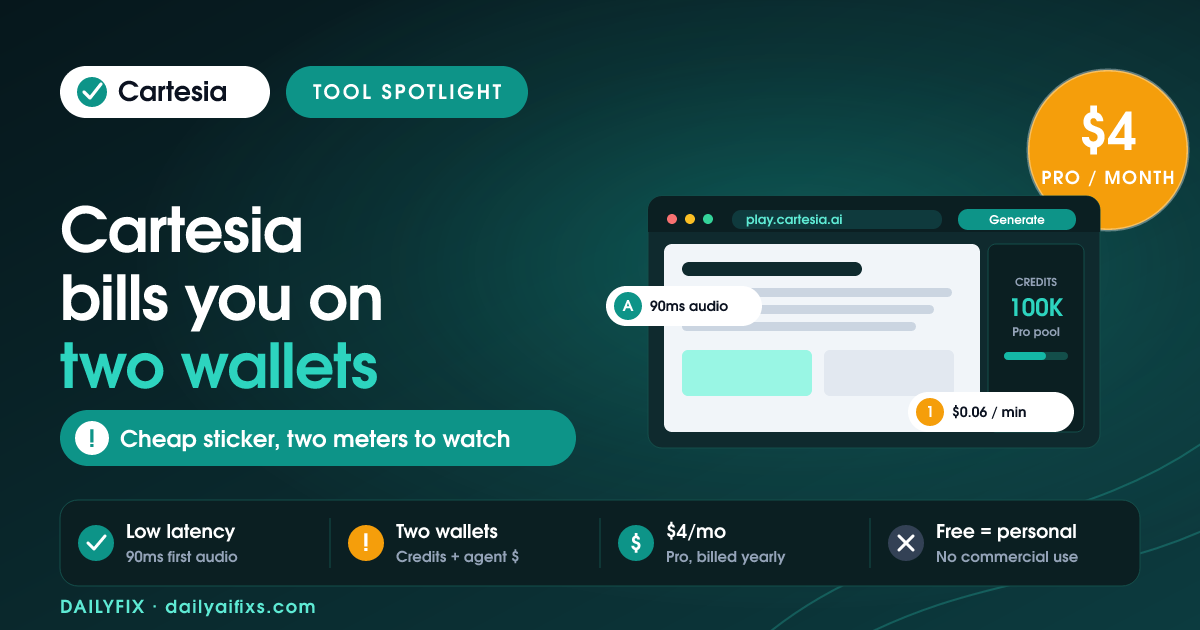
TL;DR: Cartesia pricing runs from a free plan to $239/month, with Pro at just $4/month billed yearly. The catch: you pay from two separate wallets. Model credits cover text-to-speech and speech-to-text, while a prepaid agent-dollars balance covers voice-agent telephony and LLM usage. Sticker prices look tiny; real cost depends on both meters.
Last updated: July 2026 · By Sandeep Singh, DailyFix
Cartesia is one of the fastest-moving voice AI companies right now, and its Sonic-3 text-to-speech model advertises a 90ms time-to-first-audio, which is why builders keep picking it for real-time phone and web voice agents. As of July 2026, its pricing looks almost too cheap at the top of the page. The honest answer is that the sticker prices are real, but they only tell half the story, because Cartesia meters usage across two independent balances.
What are the Cartesia pricing plans in 2026?
Cartesia has five tiers: Free ($0), Pro ($4/month billed yearly), Startup ($39/month billed yearly), Scale ($239/month billed yearly), and custom Enterprise. According to Cartesia's pricing page (checked July 2026), every paid plan bundles a monthly pool of model credits plus a separate prepaid balance for voice agents, and higher tiers raise both pools plus your concurrency limits.
The jump between tiers is mostly about scale, not features. Pro unlocks commercial use and instant voice cloning. Startup adds shared API keys, pro voice cloning, and multiple agents. Scale is built for high concurrency, with 10 agent slots and 60 concurrent calls. If you are a solo freelancer testing a client's phone agent, Pro or Startup is the realistic starting point, not Free.
What does the Cartesia free plan not let you do?
The Cartesia free plan is personal-use only, so you cannot legally use anything you generate in client work or a live product. It gives you 20,000 model credits and $1 of prepaid agent dollars, one agent slot, and Discord-only support. It is a sandbox to hear the voices, not a plan you can ship on.
That personal-use restriction is the single most missed detail. Twenty thousand credits sounds generous until you learn one credit equals one character of speech, so the free pool is roughly 20 minutes of generated audio. And the moment you want to bill a client for a voice agent built on Cartesia, you must be on Pro or higher. Treat Free as an audition, not a runway.
How do Cartesia credits and prepaid agent dollars work?
Cartesia bills from two wallets that never mix. Model credits pay for Sonic text-to-speech at 1 credit per character and Ink speech-to-text at 1 credit per second. Prepaid agent dollars pay for the Line voice-agent runtime: telephony and LLM usage per minute. Running out of one does not touch the other.
Here is where the sticker price bites. Pro includes 100,000 model credits a month. Instant voice cloning is free to clone and then charges 1 credit per character generated, which is fine. But pro voice cloning, the higher-quality option, costs 1,000,000 credits just to train, per Cartesia's pricing page (checked July 2026). That is ten times a Pro month's entire credit pool, so you physically cannot train a pro clone on Pro. Voice-changer work adds 15 credits per second on top. The credits vanish faster than the dollar figure suggests.
What does a Cartesia voice agent cost per minute?
A Cartesia Line voice agent costs $0.06 per minute of telephony plus $0.014 per minute of LLM usage, and that LLM charge is waived during a promotional window as of July 2026. On top of that, every call still burns Sonic credits for the spoken replies and Ink credits for transcription, drawn from your model-credit pool.
So the "per minute" number is not one number. A one-minute call might cost roughly $0.06 in telephony plus a few hundred model credits for the speech it generates and hears. That is competitive with rivals, but you have to add both meters to compare honestly. When you price a client retainer, budget the telephony dollars and the model credits as two line items, or a busy month will surprise you.
Cartesia vs ElevenLabs pricing: which wins for voice agents?
For real-time voice agents, Cartesia usually wins on latency and entry price, while ElevenLabs wins on voice-library depth and produced-audio tooling. Cartesia's Pro is $4/month with a 90ms time-to-first-audio; ElevenLabs leans toward larger creative and dubbing workflows. Independent 2026 voice-AI comparisons repeatedly rank Cartesia among the fastest streaming TTS options.
The practical split: if you are building phone or web agents where every 100ms of delay hurts the conversation, Cartesia's speed and cheap entry tier make it the stronger pick. If your work is long-form narration, audiobooks, or dubbing across many stock voices, ElevenLabs is more complete. Many builders end up using Cartesia for the live agent voice and something else for produced content.
Cartesia plan comparison (2026)
| Plan | Price | Model credits | Prepaid agent $ | Key unlock |
|---|---|---|---|---|
| Free | $0/mo | 20,000 | $1 | Personal use only |
| Pro | $4/mo (yearly) | 100,000 | $5 | Commercial use + instant cloning |
| Startup | $39/mo (yearly) | 1,250,000 | $49 | Pro voice cloning + orgs |
| Scale | $239/mo (yearly) | 8,000,000 | $299 | High concurrency + priority support |
| Enterprise | Custom | Custom | Custom | SLAs, SSO, HIPAA |
Voice agents also bill $0.06/min telephony + $0.014/min LLM (LLM free during a July 2026 promo). Prices and limits change often — verify on the official pricing page before deciding.
Frequently asked questions
Is Cartesia free to use?
Yes. Cartesia has a free plan at $0/month with 20,000 model credits and $1 of prepaid agent dollars. It is personal-use only, so you cannot use anything you generate commercially. To use output in client work you need Pro at $4/month billed yearly, which adds commercial rights and instant voice cloning.
How much does a Cartesia voice agent cost per minute?
Cartesia's Line voice agents bill telephony at $0.06 per minute plus $0.014 per minute of LLM usage, and the LLM charge is free during a promotional period as of July 2026. Text-to-speech and speech-to-text are billed separately as model credits, so your true per-minute cost is telephony plus whatever Sonic and Ink credits the call burns.
What is a Cartesia credit worth?
One Cartesia credit equals one character of Sonic text-to-speech or one second of Ink speech-to-text. So 100,000 credits on the Pro plan is roughly 100,000 characters of generated speech, which is around 100 minutes of audio if you spend the whole pool on text-to-speech alone.
Can I clone a voice on the Cartesia Pro plan?
You can use instant voice cloning on Pro, which is free to clone and then charges 1 credit per character generated. But Pro voice cloning, the higher-quality option, costs 1,000,000 credits just to train. Pro only includes 100,000 credits a month, so training a Pro clone is impossible without the Startup plan or a credit top-up.
Is Cartesia cheaper than ElevenLabs?
For voice-agent text-to-speech, Cartesia is generally cheaper and faster, with a 90ms time-to-first-audio and a $4/month Pro tier. ElevenLabs has a larger voice library and more mature dubbing tools. If you are building real-time phone or web voice agents, Cartesia usually wins on latency and price; for produced audio and dubbing, ElevenLabs is stronger.
Do unused Cartesia credits roll over?
Cartesia's paid subscriptions include rollover credits, but the amount you keep is tied to your tier, and changing tiers can reset what carries forward. Prepaid agent dollars are a separate balance from model credits and are consumed by telephony and LLM usage. Always check your current tier's rollover terms before you downgrade, because the two balances do not transfer into each other.
Who should not use Cartesia?
Skip Cartesia if you want a no-code, drag-and-drop voice agent builder, since Line is code-first and assumes you can work with an SDK. It is also a poor fit if your main need is long-form dubbing or a huge stock voice library. For those, ElevenLabs or a no-code platform like Synthflow will get you live faster.
Bottom line
Cartesia is a strong, genuinely cheap entry into fast voice AI, and Pro at $4/month is one of the best deals in the category for a developer who can work in code. Buy Pro if you are shipping real-time voice agents and want the lowest latency for the money. Move to Startup once you need pro voice cloning, since Pro's credit pool cannot train one. Skip Cartesia if you want no-code drag-and-drop building or long-form dubbing. Just remember you are billed on two wallets, so price both meters before you quote a client.
Sources
- Cartesia official pricing page (checked July 2026)
- Future AGI — Best Voice AI, 2026 comparison
Related reads
- Vapi Pricing 2026: The Real Cost Per Minute
- ElevenLabs Pricing 2026: The Commercial Catch
- Synthflow Pricing 2026: The Real Per-Minute Cost
- Retell AI Pricing 2026: The $0.07/Minute Myth
- Bland AI Pricing 2026: What a Call Really Costs