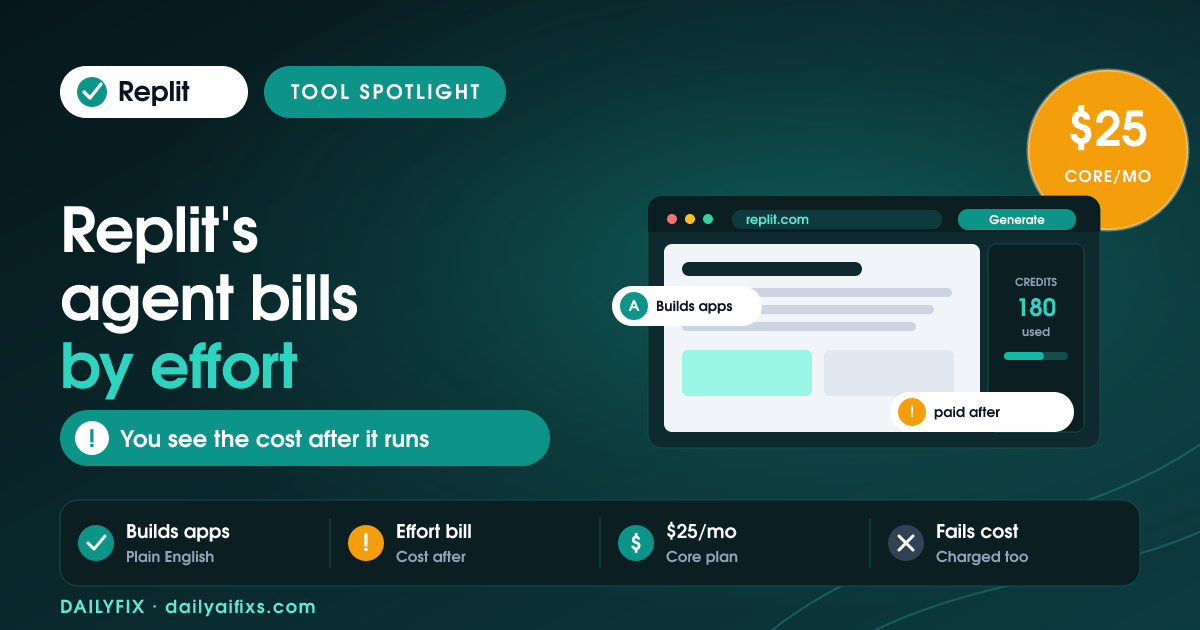
Replit pricing in 2026 is $0 Starter, $25/month Core (about $20/month billed annually), plus Teams and custom Enterprise tiers. The catch is effort-based billing. Replit Agent charges by how much work a task takes, bundled into "checkpoints," and you do not see the price until after the checkpoint is created and your credits are debited — including for attempts that fail.
Replit is a browser-based coding platform whose Agent can build and deploy full apps from plain-English prompts. It is powerful, but its 2026 billing model is the most divisive part of the product. The plan price is only half the story — the Agent's effort-based charges decide what you actually spend. Here is how every tier works, based on Replit's pricing page and independent breakdowns as of July 2026.
How much does Replit cost in 2026?
Replit costs $0 on the Starter plan, $25/month on Core (about $20/month billed annually), with Teams priced per seat and Enterprise on a custom quote. Core includes a monthly allotment of credits that power the Agent, deployments, and compute. Above that allotment, you pay for usage. The plan mostly buys you a monthly credit balance and higher limits, not a fixed number of builds.
| Plan | Price (monthly) | What you get | Best for |
|---|---|---|---|
| Starter | $0 | Limited Agent access, public apps | Trying Replit, learning |
| Core | $25 (~$20 annual) | Monthly credits for Agent + deploys, private apps | Solo builders shipping apps |
| Teams | Per seat | Core plus shared workspaces, roles | Small dev teams |
| Enterprise | Custom | SSO, security, admin controls | Larger organizations |
Prices and limits change often — verify on the official pricing page before deciding.
What is effort-based pricing on Replit?
Effort-based pricing means Replit's Agent charges by how much work a request takes, not a flat per-message rate. Replit decides the effort, bundles the work into a "checkpoint," and debits credits when the checkpoint completes. A simple styling change may cost under $0.25 (roughly 5–20 credits), while a complex feature can run 150–300+ credits. Bigger tasks cost more because they represent more effort.
The friction is that the cost is revealed after the fact. You approve a task, the Agent works, and only once the checkpoint lands do you see what it charged. That makes budgeting harder than a fixed subscription, and it is why some users describe effort-based pricing as feeling like a slot machine — you pull the lever, then find out the price.
Why do failed Replit tasks still cost credits?
Replit's Agent can charge credits even when a task does not fully succeed, because you are billed for the effort spent, not the outcome delivered. If the Agent attempts a feature, loops, or makes a mistake you then have to correct, that work still consumes credits. Users have reported paying for attempts that got stuck or needed re-doing, which is the sharpest edge of the effort-based model.
The practical defense is to keep requests small and specific. Break big features into narrow checkpoints so a failure costs less and is easier to diagnose. Vague, sprawling prompts are the most expensive way to use Replit — they invite long, uncertain Agent runs that can burn credits before producing anything you can ship. Precision is not just good practice here; it is cost control.
Which Replit plan should a builder pick?
For a solo builder shipping real apps, Replit Core at $25/month (about $20 annual) is the plan to start with — it unlocks private apps, deployments, and a monthly credit balance for the Agent. Starter is for learning and testing the workflow on public projects. Teams and Enterprise only make sense once you have collaborators or need admin and security controls.
Before relying on Replit for a project, run a week on Core and watch how fast the Agent draws down credits on your actual tasks. Effort-based billing rewards tight prompts and punishes sprawling ones, so your habits matter as much as the plan. If you consistently blow past Core's included credits, price the usage overage against your output before assuming a bigger commitment is cheaper.
Replit pricing FAQ
Is Replit free in 2026?
Replit has a Starter plan at $0 that gives limited Agent access and lets you build public apps — enough to learn the platform and test the workflow. Serious work needs Core at $25/month (about $20 annual), which adds private apps, deployments, and a monthly credit balance for the Agent. The free tier is a genuine trial, but the Agent limits and public-only apps push most builders to Core quickly.
How much is Replit Core?
Replit Core is $25 per month, or about $20/month billed annually. It includes private apps, deployments, higher compute, and a monthly allotment of credits that power the Agent. Because the Agent bills by effort, how far Core's credits stretch depends entirely on your tasks — simple edits cost little, complex features cost a lot. Usage beyond the monthly allotment is billed on top.
How does Replit's effort-based pricing work?
Replit's effort-based pricing charges the Agent by how much work a task requires, bundled into a checkpoint. Simple changes can cost under $0.25 (about 5–20 credits); complex features can run 150–300+ credits. Replit decides the effort, and you see the cost only after the checkpoint completes and credits are debited. This makes spending harder to predict than a flat subscription, so tight, specific prompts help control cost.
Does Replit charge for failed attempts?
Yes. Because Replit bills for effort rather than results, the Agent can consume credits even when a task loops, errors, or produces work you then have to fix. Users have reported paying for attempts that got stuck. The best way to limit this is to break work into small, specific checkpoints so a failure costs less and is easier to correct, rather than issuing large, open-ended requests.
Is Replit worth it for a non-coder?
Replit is worth it for a non-coder who wants to build and deploy a real app from plain English, provided you accept the effort-based billing. Core at $25/month gives you the Agent, hosting, and private apps. The risk is cost unpredictability: vague prompts trigger long, expensive Agent runs. Start on Starter to learn the flow, keep requests narrow, and move to Core once you have a concrete project.
The bottom line on Replit pricing in 2026
Replit is one of the most capable build-from-a-prompt tools in 2026, and Core at $25/month is the plan most solo builders should buy. The number that decides your real cost is not the subscription — it is the Agent's effort-based credit burn, revealed after each checkpoint and charged even for failed attempts. Keep prompts small and specific to control spend, and watch your credit draw for a week before committing. Verify current rates on Replit's official pricing page.
Sources: Replit pricing page (replit.com/pricing), Replit's effort-based pricing announcement (blog.replit.com/effort-based-pricing), and No Code MBA — all retrieved July 2026.