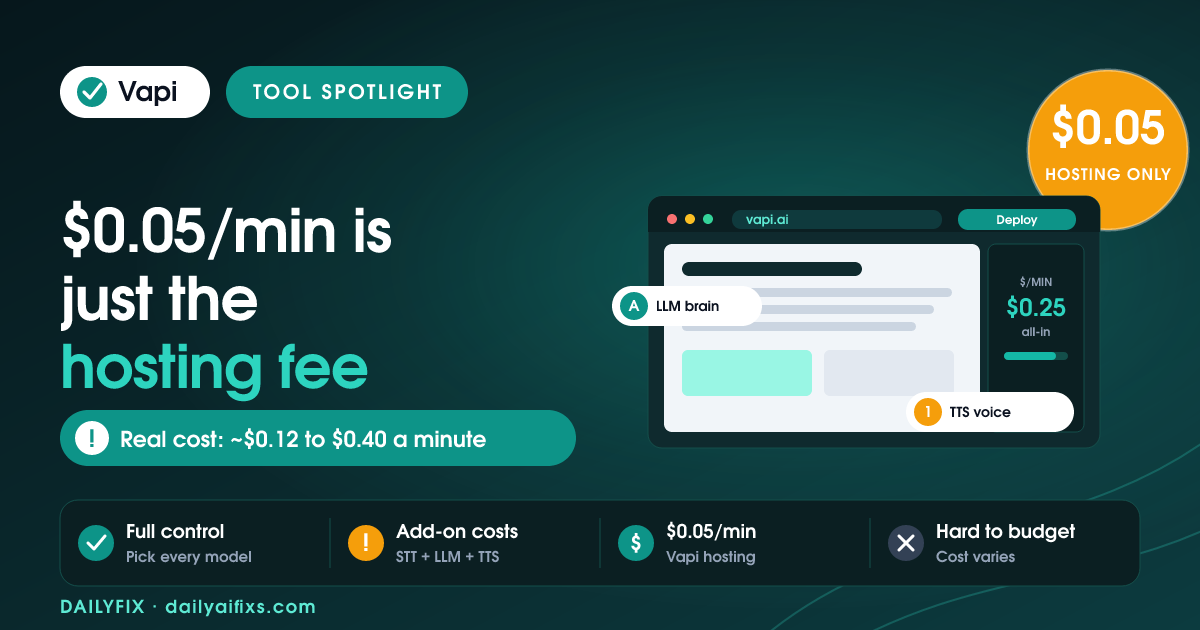
Vapi pricing in 2026 starts at $0.05 per call minute on the self-serve Build plan, but that number is only Vapi's hosting fee. Speech-to-text, the language model, text-to-speech, and telephony are billed separately at cost. Add them up and the real all-in cost of a Vapi voice agent runs roughly $0.12 to $0.40 per minute, based on Vapi's pricing page and independent breakdowns as of July 2026.
How much does Vapi cost in 2026?
Vapi costs $0.05 per call minute for hosting on the Build plan, with no fixed monthly platform fee, according to the official Vapi pricing page as of July 2026. Build is usage-based: you get about $10 in free credits and 60-plus included minutes to test, then pay per minute after that. The catch is that $0.05 buys only the container hosting for your agent, not the AI services that actually make the call work.
Vapi runs a voice agent as a stack of separate services. Speech-to-text (STT) turns the caller's voice into text, a large language model (LLM) generates the reply, text-to-speech (TTS) turns that reply back into a voice, and a telephony provider carries the call. Each of those is a paid service billed on top of the $0.05 hosting fee. Vapi passes those provider costs through at cost, and lists them as $0 on Vapi's side if you bring your own API keys — but you still pay the providers directly.
What is the real all-in cost of a Vapi minute?
The real all-in cost of a Vapi minute is roughly $0.12 to $0.40, not $0.05. The $0.05 hosting fee is one line on a bill that also includes transport, speech-to-text, language-model tokens, and text-to-speech. A lean stack lands near $0.12 per minute, a standard stack near $0.25, and a premium stack around $0.40, based on the cost profiles published in independent 2026 breakdowns.
The difference comes almost entirely from the language model and the voice. A cheap, fast LLM with a basic voice keeps you at the low end. A top-tier reasoning model paired with a premium, natural-sounding voice pushes you toward the high end. Here is how a single minute breaks down across three common setups.
| Cost layer | Lean setup | Standard setup | Premium setup |
|---|---|---|---|
| Vapi hosting | $0.05 | $0.05 | $0.05 |
| Transport / telephony | ~$0.01 | ~$0.015 | ~$0.02 |
| Speech-to-text (STT) | ~$0.01 | ~$0.02 | ~$0.03 |
| Language model (LLM) | ~$0.02 | ~$0.08 | ~$0.13 |
| Text-to-speech (TTS) | ~$0.03 | ~$0.08 | ~$0.10 |
| Total per minute | ~$0.12 | ~$0.25 | ~$0.40 |
Sample estimates from independent 2026 breakdowns, not fixed Vapi prices. Prices and limits change often — verify on the official Vapi pricing page before deciding.
What does Vapi cost per month at real call volume?
Vapi's monthly cost scales with total call minutes, so a busy month adds up fast. At $0.05 per minute, 1,000 calls of four minutes each equals 4,000 minutes and $200 in Vapi hosting alone. Add the provider stack and that same month realistically lands between about $480 (lean) and $1,600 (premium), based on the example scenarios on Vapi's own usage calculator and independent breakdowns.
The lesson for a solopreneur or small agency is to model minutes before you launch, not after the first invoice. A low-volume appointment-booking bot is cheap. A high-volume support line is a real monthly expense. The table below shows how the same call volume changes cost depending on your stack.
| Monthly volume | Total minutes | Hosting only | Lean total | Premium total |
|---|---|---|---|---|
| 100 calls × 3 min | 300 | $15 | ~$36 | ~$120 |
| 1,000 calls × 4 min | 4,000 | $200 | ~$480 | ~$1,600 |
| 5,000 calls × 2 min | 10,000 | $500 | ~$1,200 | ~$4,000 |
| 10,000 calls × 5 min | 50,000 | $2,500 | ~$6,000 | ~$20,000 |
Prices and limits change often — verify on the official Vapi pricing page before deciding.
What is the difference between Vapi Build and Scale?
Vapi Build is the self-serve, pay-as-you-go plan with no contract, while Vapi Scale is a custom annual contract for production and enterprise use. Build charges $0.05 per minute for hosting, includes 10 concurrent call lines (extra lines are $10 per line per month), and offers only email and Discord community support. Scale replaces usage-only billing with a fixed platform fee plus committed volume and volume-based per-minute rates.
The gap is mostly about compliance and support, not raw price. Build gives you 14 days of call history, 30 days of chat history, and no SSO, RBAC, or SOC 2. Scale adds SOC 2, HIPAA, PCI, SSO, RBAC, data residency, an infrastructure and support SLA, a named support engineer, and a dedicated account team. On both plans, HIPAA is a $2,000-per-month add-on and Zero Data Retention is $1,000 per month. If you are handling patient or payment data, budget for those add-ons from day one.
How can you keep Vapi costs down?
The fastest way to keep Vapi costs down is to bring your own API keys and pick a lean model-and-voice stack. When you supply your own STT, LLM, and TTS keys, Vapi lists those provider costs as $0 on its side, so you pay only the $0.05 hosting fee plus what each provider charges you directly, with no Vapi markup. That alone lets you shop for cheaper providers per layer.
Beyond keys, three levers matter most: model choice, voice choice, and call length. A cheaper, faster LLM for simple tasks like lead qualification can cut the biggest single cost. A standard voice instead of a premium one trims TTS. And tighter prompts and shorter calls reduce every per-minute layer at once. We based this on Vapi's official pricing page and two independent 2026 breakdowns; the consistent theme is that the stack, not the $0.05 headline, decides your bill.
Frequently asked questions
How much does Vapi cost per minute in 2026? Vapi charges $0.05 per call minute for hosting on the Build plan in 2026, but that is only the platform layer. Speech-to-text, the language model, text-to-speech, and telephony are billed separately at cost. Independent 2026 breakdowns put the real all-in cost between roughly $0.12 and $0.40 per minute depending on the models and voices you choose.
Is Vapi free to try? Vapi's Build plan is self-serve with no fixed monthly platform fee, and new accounts get about $10 in free credits plus 60-plus included call minutes to test. There is no free production tier: once credits run out you pay $0.05 per minute for hosting plus the pass-through provider costs for speech-to-text, the language model, and text-to-speech.
Why is Vapi pricing so hard to predict? Vapi pricing is hard to predict because the final bill is not one flat fee. You pay $0.05 per minute for Vapi hosting, then separate charges for speech-to-text, language-model tokens, text-to-speech, and telephony. Two teams with identical call volume can pay very different amounts based on model choice, prompt length, call duration, and concurrency add-ons.
What does the Vapi Scale plan cost? The Vapi Scale plan has no public price. It is an annual contract with a fixed platform fee, committed volume, and volume-based per-minute rates, quoted by sales. Scale adds enterprise features Build lacks: SOC 2, HIPAA, PCI, SSO, RBAC, data residency, a support SLA, and a dedicated account team. HIPAA and Zero Data Retention are $2,000 and $1,000 per month add-ons on both plans.
Can you cut Vapi costs by bringing your own API keys? Yes. On the Build plan, if you bring your own API keys for speech-to-text, the language model, and text-to-speech, Vapi lists those provider costs as $0 on its side, so you only pay Vapi's $0.05 per minute plus what you owe each provider directly. It does not make the call free, but it removes any Vapi markup and lets you shop for cheaper providers.
The bottom line
Vapi is one of the most flexible voice-agent platforms in 2026, and its pricing is transparent once you read past the headline. Just remember that $0.05 per minute is Vapi's hosting fee, not the cost of a call. Budget for the full stack — expect $0.12 to $0.40 per minute all-in — bring your own API keys to kill any markup, and model your call minutes before launch so the first invoice holds no surprises.
Figures verified against the official Vapi pricing page and independent breakdowns as of July 2026. Verify current prices before committing.