Glide Pricing 2026: The Per-User Update Bill
TL;DR: Glide pricing in 2026 has five tiers: Free, Explorer (~$19/mo annual, $25 monthly), Maker (~$49/mo annual, $60 monthly), Business ($199/mo annual), and custom Enterprise. The catch is usage: your real bill is driven by signed-in users, connected data sources, and monthly updates, with Business overages around $5–$6 per extra user and $0.02 per extra update.
Last updated: August 2026 · By Sandeep Singh, DailyFix
Glide is a no-code platform for turning spreadsheets and databases into apps. As of August 2026, Glide pricing (restructured effective November 1, 2025) charges a monthly plan fee, but the number that actually moves your bill is usage — users and app updates. Here is what each tier costs and how the overage math works.
What does the Glide free plan include?
The Glide free plan costs $0 and is best for learning, prototyping, and personal projects, limited to one app with restricted updates and features. It lets you build and preview an app but is not meant for production use.
The free tier is a genuine sandbox, but the single-app limit and capped updates mean anything with real users quickly needs a paid plan. It is ideal for testing whether Glide fits your idea before you commit money.
How much do the Glide Explorer and Maker plans cost?
The Glide Explorer plan costs about $19 per month billed annually ($25 monthly), and the Maker plan costs about $49 per month annually ($60 monthly). According to Glide pricing checked in August 2026, all paid plans include unlimited apps within your workspace.
Explorer suits a solo maker with a small app, while Maker adds capacity for individuals building more seriously. Annual billing saves roughly 20% over monthly, so committing yearly is the cheaper route if you plan to keep the app running.
What do Glide Business plan overages cost?
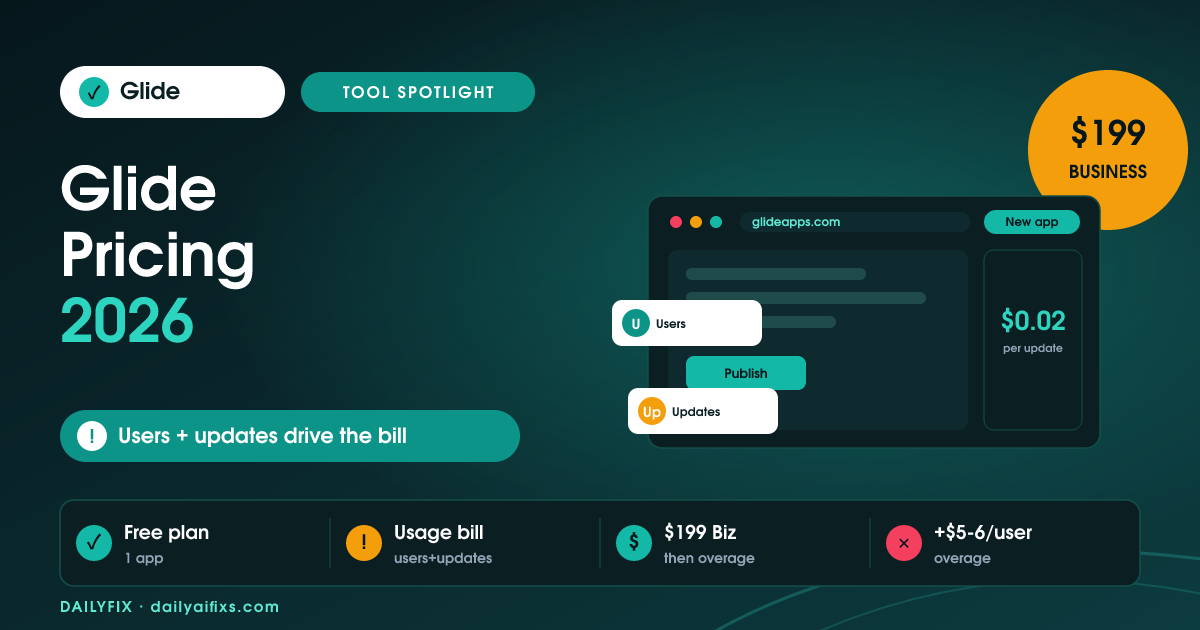
The Glide Business plan starts at $199 per month billed yearly, and its overages run about $5 to $6 per additional user (depending on annual versus monthly) and $0.02 per additional update. Overages are where a growing app's bill climbs.
Those per-unit charges matter at scale: an app with many signed-in users or heavy activity racks up user and update overages on top of the $199 base. Model your expected users and update volume before assuming Business is a flat fee — it is a floor, not a ceiling.
How do Glide updates and users drive billing?
Glide billing is driven by how many signed-in users your app has, which data sources you connect (external sources like Google Sheets or SQL weigh more), and how many monthly updates your apps generate. These usage levers, not just the plan tier, determine your real cost.
An update is essentially a data change or sync event, so a busy app with frequent writes generates many updates. Two apps on the same plan can cost very differently depending on users and update volume, which is why estimating usage up front is essential.
Is Glide pricing right for no-code apps?
Glide pricing is right for no-code apps when you match the tier to your users and update volume — Explorer or Maker for small internal or personal apps, Business for team apps with real usage. It is less predictable for high-traffic apps where overages stack up.
The honest read: Glide is powerful and the entry plans are fair, but the usage-based billing means a popular app can cost well above its plan's sticker. Forecast signed-in users and updates, prefer efficient data sources, and revisit the math as your app grows before overages surprise you.
| Plan | Price / month | Notes | Best for |
|---|---|---|---|
| Free | $0 | 1 app, limited updates | Learning and prototyping |
| Explorer | ~$19 (annual) / $25 monthly | Unlimited apps in workspace | Solo makers, small apps |
| Maker | ~$49 (annual) / $60 monthly | More capacity | Individuals building seriously |
| Business | $199 (annual) | +$5–$6/user, +$0.02/update overages | Team apps with real usage |
| Enterprise | Custom | Custom limits and support | Large organizations |
Prices and limits change often — verify on the official pricing page before deciding.
Frequently asked questions
Is Glide free?
Glide has a free plan for learning, prototyping, and personal projects, limited to one app with restricted updates and features. It is good for testing an idea, but apps with real users need a paid tier like Explorer, Maker, or Business.
How much does Glide cost?
Glide costs about $19 per month for Explorer and $49 for Maker (billed annually), while Business starts at $199 per month annually, according to pricing checked in August 2026. Enterprise is custom, and annual billing saves roughly 20% over monthly.
What drives my Glide bill beyond the plan?
Your Glide bill is driven by signed-in users, connected data sources, and monthly updates. On Business, overages run about $5 to $6 per extra user and $0.02 per extra update, so a busy app can cost well above the $199 base.
What counts as an update in Glide?
An update is essentially a data change or sync event in your app. A busy app with frequent writes generates many updates, and on the Business plan extra updates beyond your allowance cost about $0.02 each, adding to the base price.
Does Glide charge per user?
On the Business plan, additional signed-in users beyond your allowance cost about $5 to $6 each per month, depending on annual versus monthly billing. User count is a major cost lever, so estimate your app's active users before choosing a tier.
Which data sources cost more in Glide?
External data sources like Google Sheets or SQL weigh more in Glide's usage model than its built-in data. If you connect heavy external sources, factor that into your expected cost, since it influences your bill alongside users and updates.
Is Glide good for internal team apps?
Yes. Glide suits internal team apps, and the Business plan at $199 per month is aimed at that use. Just model your signed-in users and update volume, because overages for extra users and updates can push a busy team app above the base price.
When did Glide change its pricing?
Glide's current five-tier pricing structure took effect November 1, 2025, according to pricing checked in August 2026. All paid plans now include unlimited apps within a workspace, with billing driven by users, data sources, and updates.
Bottom line
Glide is a capable no-code app builder, and its entry plans — Explorer around $19 and Maker around $49 per month — are fair for small personal or internal apps. The catch is usage-based billing: signed-in users, external data sources, and monthly updates drive your real cost, and the $199 Business plan adds roughly $5–$6 per extra user and $0.02 per extra update. Pick Explorer or Maker for small apps and Business for team apps with real usage, but forecast users and updates first — a popular Glide app can cost well above its plan's sticker.
Sources
Related reads
- Softr Pricing 2026: The App-User Ceiling
- Base44 Pricing 2026: The Message Credit Catch
- Framer Pricing 2026: The Hidden Seat Fee
- Durable Pricing 2026: Free Is a Subdomain
- Replit Pricing 2026: The Effort-Based Catch