LiveKit Pricing 2026: The Agent-Minute Catch
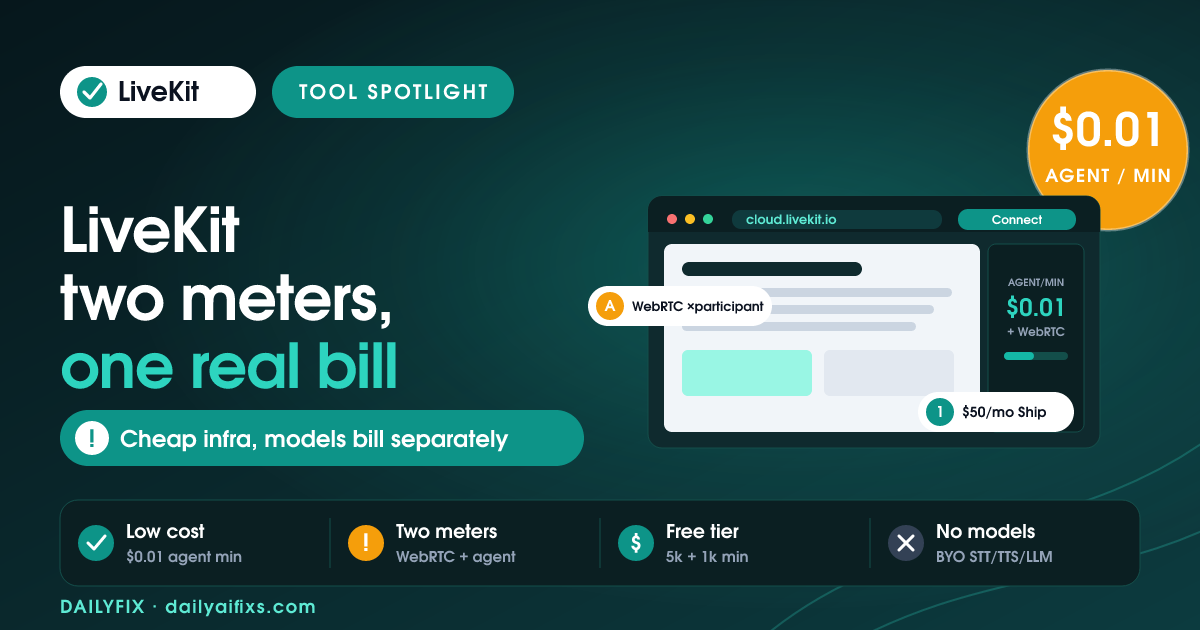
TL;DR: LiveKit pricing runs from a free Build tier to $500/month Scale, with Ship at $50/month in between. The catch: two meters bill you at once. WebRTC minutes are counted per participant, and agent session minutes cost about $0.01/min on top. LiveKit is cheap infrastructure, but the speech and LLM providers you plug in bill you separately.
Last updated: July 2026 · By Sandeep Singh, DailyFix
LiveKit is the real-time backbone behind a huge share of 2026's voice agents, including large realtime deployments, because it handles the hard part of streaming audio between humans and AI. As of July 2026, its pricing looks simple on the plan cards. The subtlety is that "minutes" means two different things, and the cheaper-looking meter is not the one that drives your bill.
What are the LiveKit pricing plans in 2026?
LiveKit has three public plans plus Enterprise: Build ($0), Ship ($50/month), and Scale ($500/month). According to LiveKit's pricing page and independent breakdowns (checked July 2026), Ship includes 150,000 WebRTC minutes and Scale includes 1.5 million, with per-minute overage after that. Higher tiers raise included minutes, concurrency and support.
The plan you pick is really about volume and support, not features. Build is for prototyping, Ship is for a live small-to-mid app, and Scale is for high-traffic production. For a solo developer shipping a client's voice agent, Ship at $50 is usually the first paid step, and its 150,000 included WebRTC minutes go a long way before overage kicks in.
What does the LiveKit free plan include?
The LiveKit free Build plan includes 5,000 WebRTC minutes and 1,000 AI agent minutes per month, with no card required. That is enough to build and demo a working voice or video app, and to test an AI agent end to end before spending anything.
The limit that bites first is the 1,000 agent minutes, not the 5,000 WebRTC minutes. Agent minutes are the ones a conversational AI burns, so a handful of long test calls can exhaust them quickly. Treat Build as a real prototyping tier, but expect to upgrade to Ship the moment an agent goes into regular use, because agent minutes are the scarce currency here.
How do LiveKit WebRTC minutes work?
A LiveKit WebRTC minute is one participant connected for one minute, counted per participant. So a two-person call lasting ten minutes uses twenty WebRTC minutes, and an AI agent that joins the call counts as another participant. Overage is $0.0005 per minute on Ship and $0.0004 per minute on Scale.
This per-participant math is the most misread part of LiveKit pricing. People divide their included minutes by call length and forget to multiply by the number of participants. A group room with five people burns five times the minutes of a one-on-one. The rates are tiny, so this rarely breaks the bank, but it matters when you forecast a busy multi-party product.
What do LiveKit agent session minutes cost?
LiveKit agent session minutes cost about $0.01 per minute and are the primary cost driver for conversational AI, because they meter the time your AI agent is actively running in a session. This is separate from WebRTC minutes and separate again from the speech and LLM providers you connect.
Here is the full stack for one minute of a talking agent: a WebRTC minute for the caller, a WebRTC minute for the agent participant, an agent session minute at roughly $0.01, plus your Deepgram or Cartesia and LLM usage billed by those vendors. LiveKit's own slice is cheap; the honest per-minute cost is the sum. Price all of it before you quote a retainer.
LiveKit vs Vapi pricing: which is cheaper for voice agents?
LiveKit is generally cheaper at the infrastructure layer because agent minutes are only about $0.01 and you supply your own models, while Vapi bundles orchestration at around $0.05 per minute plus those same models. LiveKit trades a lower price for more engineering; Vapi trades a higher price for a faster, managed launch.
The decision is about who does the wiring. If you are comfortable assembling speech-to-text, text-to-speech and an LLM and running a backend, LiveKit gives you the lowest cost and the most control. If you want a voice agent live this week without gluing providers together, Vapi or a no-code platform is worth the premium. Many teams prototype on Vapi, then rebuild on LiveKit to cut cost at scale.
LiveKit plan comparison (2026)
| Plan | Price | Included WebRTC min | Included agent min | Overage |
|---|---|---|---|---|
| Build | $0 | 5,000 | 1,000 | — |
| Ship | $50/mo | 150,000 | varies | $0.0005/min WebRTC |
| Scale | $500/mo | 1,500,000 | varies | $0.0004/min WebRTC |
| Enterprise | Custom | Custom | Custom | Custom |
Agent session minutes bill around $0.01/min on top, and model providers (STT/TTS/LLM) bill separately. Prices and limits change often — verify on the official pricing page before deciding.
Frequently asked questions
Is LiveKit free?
Yes. LiveKit's Build tier is free and includes 5,000 WebRTC minutes plus 1,000 AI agent minutes per month, which is enough to prototype a voice or video app. There is no card required to start. Once you exceed those quotas or need higher limits, you move to Ship at $50 per month.
How much does LiveKit cost per month?
LiveKit has three public plans as of July 2026: Build at $0, Ship at $50 per month, and Scale at $500 per month, plus custom Enterprise. Ship includes 150,000 WebRTC minutes and Scale includes 1.5 million, with cheap per-minute overage after that. Agent session minutes are billed separately on top.
What is a WebRTC minute in LiveKit?
A LiveKit WebRTC minute is one participant connected for one minute. It is counted per participant, so a two-person call for ten minutes uses twenty WebRTC minutes, and an AI agent joining a call also counts as a participant. Overage is $0.0005 per minute on Ship and $0.0004 per minute on Scale.
What do LiveKit agent session minutes cost?
LiveKit agent session minutes cost about $0.01 per minute and are the main cost driver for conversational AI, because they meter the time your AI agent is actively running in a session. This is separate from WebRTC minutes, and it does not include the speech-to-text, text-to-speech or LLM providers you plug in, which bill you directly.
Is LiveKit cheaper than Vapi?
LiveKit is usually cheaper at the infrastructure layer because you assemble and pay your own speech-to-text, text-to-speech and LLM providers, and its agent minutes are only about $0.01. Vapi bundles orchestration at around $0.05 per minute plus those providers. LiveKit wins on cost and control if you can build; Vapi wins on speed to launch.
Does LiveKit include speech-to-text and text-to-speech?
No. LiveKit is the real-time transport and agent framework, not the voice models. You bring your own speech-to-text, text-to-speech and LLM, such as Deepgram, Cartesia or OpenAI, and each of those bills you separately. Budget LiveKit's WebRTC and agent minutes plus the model providers to see your true per-minute cost.
Who should not use LiveKit?
Skip LiveKit if you want a no-code or fully managed voice agent, since it is a developer framework that assumes you will wire up your own models and backend. For a faster launch with less engineering, a managed platform like Vapi or Synthflow gets you live sooner, at a higher per-minute price.
Bottom line
LiveKit is the strongest choice when you want the lowest-cost, most controllable foundation for real-time voice and video, and the free Build tier makes it easy to prototype. Move to Ship at $50 once an agent is in regular use, since the free agent minutes run out first. Just remember LiveKit is infrastructure, not a finished voice agent: you pay WebRTC minutes per participant, agent minutes at about $0.01, and your own model providers on top. If you can build, it is a bargain. If you cannot, a managed platform is worth the premium.
Sources
- LiveKit official pricing page (checked July 2026)
- TRTC — LiveKit pricing 2026 breakdown
Related reads
- Cartesia Pricing 2026: The Two-Wallet Catch
- Deepgram Pricing 2026: The Sub-Cent Myth
- Vapi Pricing 2026: The Real Cost Per Minute
- Synthflow Pricing 2026: The Real Per-Minute Cost
- Retell AI Pricing 2026: The $0.07/Minute Myth