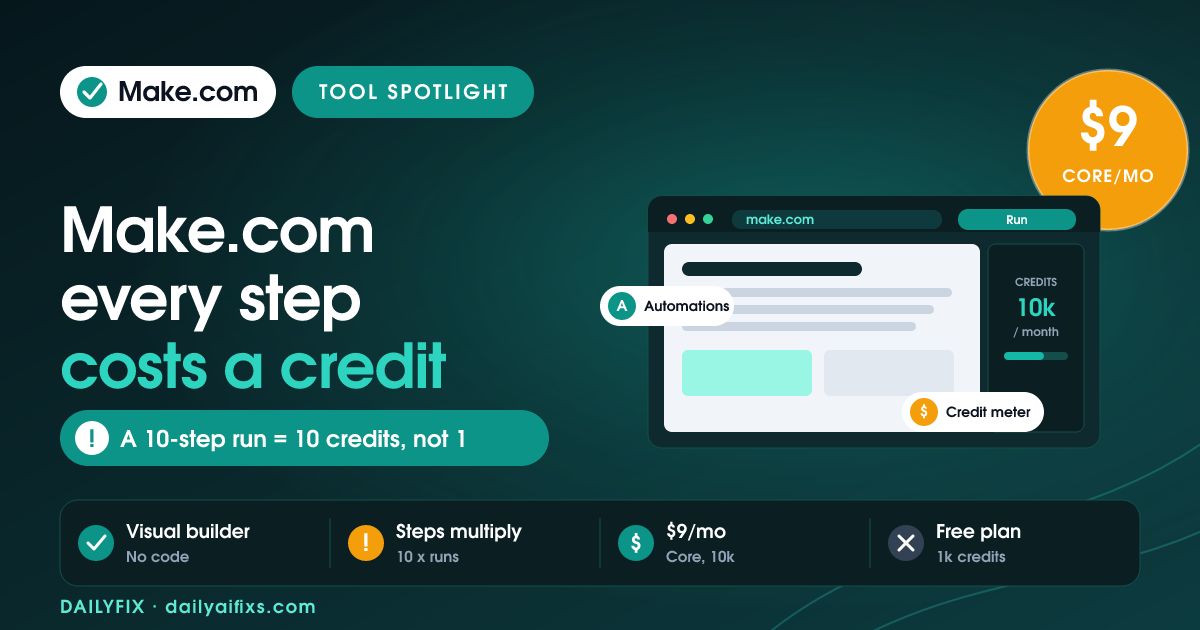
Make.com pricing in 2026 runs from Free (1,000 credits per month) through Core at $9 per month, Pro at $16, Teams at $29, and custom Enterprise, on annual billing. Paid plans start at 10,000 credits a month. The catch is the credit multiplier: each module step counts as one credit, so a 10-step scenario that runs 100 times spends 1,000 credits, not 100.
What is Make.com, and who is it for?
Make.com is a visual automation platform where you connect apps into “scenarios” that move data and trigger actions without code. You drag modules onto a canvas — a trigger, then steps — and Make runs them on a schedule or in real time. It fits solopreneurs and small teams automating repetitive work: syncing leads, posting content, updating spreadsheets, and wiring AI into workflows. Compared with simpler tools, Make gives more control over branching, filtering, and multi-step logic.
| Plan | Price (annual) | Monthly credits | Best for |
|---|---|---|---|
| Free | $0 | 1,000 | Testing simple flows |
| Core | $9 / mo | 10,000 | Solo automations |
| Pro | $16 / mo | 10,000+ (faster) | Heavier workflows |
| Teams | $29 / mo | Shared pool | Small teams |
Prices and limits change often — verify on the official pricing page before deciding.
How much does Make.com cost in 2026?
Make.com costs $0 on Free with 1,000 monthly credits, then $9 per month on Core, $16 on Pro, and $29 on Teams (annual billing), with Enterprise custom. All paid plans start at 10,000 credits a month, and higher tiers add speed and features rather than a different pricing model. Add-on packs cost about $9 per 10,000 extra credits. Here is the lineup, based on Make's pricing and independent trackers as of July 2026.
What is the Make.com credit multiplier?
Make bills in credits, and each module step in a scenario counts as one credit every time it runs. So a scenario with 10 steps that executes 100 times spends 1,000 credits, not 100 — the step count multiplies the run count. That is different from tools that charge one task per run, and it is why a busy multi-step automation can drain a plan faster than the headline credit number suggests. Make also charges 2 credits per second for custom code steps.
How does Make.com pricing compare to Zapier?
Make.com is generally cheaper per unit of work than Zapier because Core starts at $9 with 10,000 credits and add-ons cost about $9 per 10,000, versus Zapier's pricier per-task model. The trade-off is the credit multiplier: since every step counts, a complex Make scenario can use many credits per run. For high-volume, multi-step automations Make usually wins on cost, but you have to design lean scenarios to keep credit use down.
Is Make.com worth it for solopreneurs in 2026?
Make.com is worth the $9 Core plan for solopreneurs who want powerful, flexible automation without paying enterprise prices. The visual builder and 10,000 monthly credits cover a lot of everyday work like lead syncing and content posting. Just design with the credit multiplier in mind — fewer steps and smart filters mean each run costs less. If your automations are simple and low-volume, even the free 1,000 credits may carry you for a while.
Frequently asked questions
How much does Make.com cost in 2026?
Make.com runs from Free with 1,000 credits per month through Core at $9 per month, Pro at $16, Teams at $29, and custom Enterprise, on annual billing. All paid plans start at 10,000 credits a month. Add-on packs cost about $9 per 10,000 extra credits.
What is a Make.com credit?
A Make.com credit is spent each time a module step runs. Make switched from “operations” to credits in August 2025. A 10-step scenario that runs 100 times spends 1,000 credits because every step counts on every run. Custom code steps cost 2 credits per second of execution.
Why do Make.com scenarios use so many credits?
Make.com scenarios use credits per step, not per run, so the step count multiplies the number of runs. A 10-step flow running 100 times is 1,000 credits. Designing lean scenarios with fewer steps and good filters keeps credit use down and your plan lasting longer.
Is Make.com cheaper than Zapier?
Make.com is usually cheaper per unit of work, with Core at $9 for 10,000 credits and add-ons around $9 per 10,000, versus Zapier's costlier per-task pricing. The caveat is the credit multiplier: complex multi-step scenarios use more credits per run, so lean design matters for keeping costs low.
Does Make.com have a free plan?
Yes. Make.com has a free plan with 1,000 credits per month, enough to build and test simple automations. Because every module step spends a credit, busy or multi-step workflows exhaust it quickly, and the Core plan at $9 per month with 10,000 credits is the realistic next step.
Bottom line
Make.com is one of the most capable automation tools for the money, and Core at $9 a month with 10,000 credits is a strong starting point. Just respect the credit multiplier: every step spends a credit on every run, so multi-step scenarios add up. Build lean flows, watch your credit use, and Make comfortably out-values pricier per-task competitors for most solopreneurs.
Based on Make's pricing and independent trackers as of July 2026. Sources: make.com, lindy.ai, zapier.com, costbench.com. Written by Sandeep Singh for DailyFix.