Ringly.io Pricing 2026: The Pro-Only Trial Catch
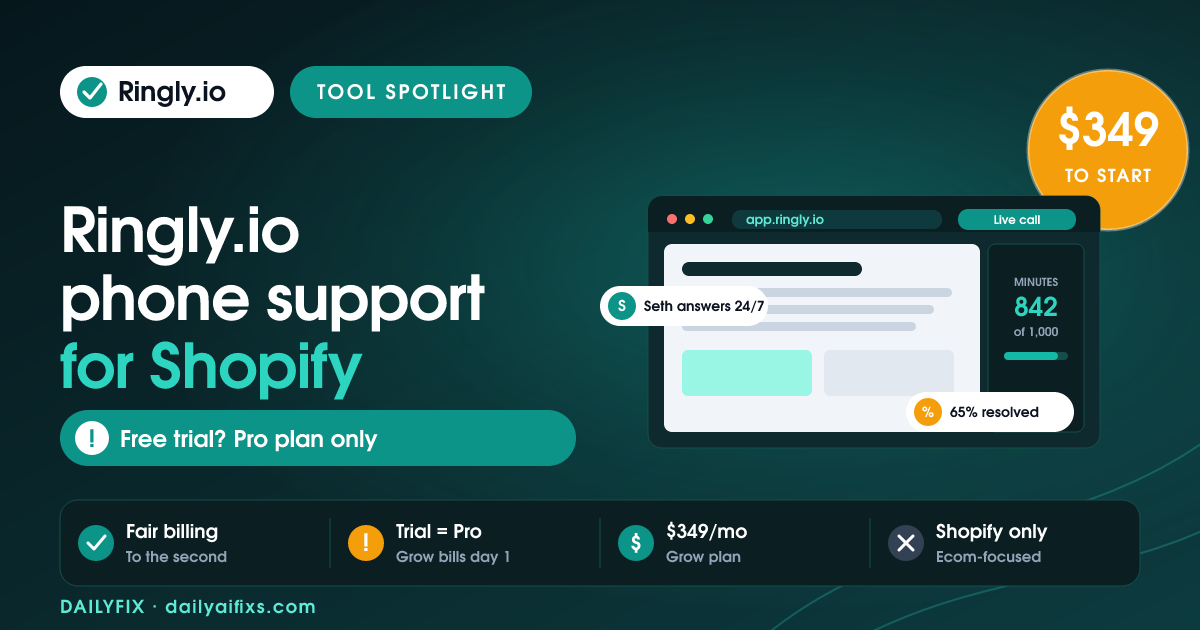
TL;DR: Ringly.io pricing 2026 starts at $349/mo (Grow) for 1,000 call minutes and runs to $799/mo (Pro) for 2,500 minutes, with $0.29 and $0.19 per-minute overages after that. The catch: the 14-day free trial is Pro-only. The $349 Grow plan bills you the moment you sign up — no trial, no free tier.
Last updated: August 2026 · By Sandeep Singh, DailyFix
Ringly.io is an AI phone support rep built for Shopify stores. Its agent, "Seth," answers inbound calls, pulls order data from Shopify, and escalates the tricky ones to your team. As of August 2026 it's one of the more talked-about voice agents for e-commerce — but its pricing hides a couple of things you should know before you add a card.
What does Ringly.io pricing 2026 include per plan?
Ringly.io pricing 2026 has two self-serve plans plus enterprise. Grow is $349/mo for 1,000 minutes (about 500 calls). Pro is $799/mo for 2,500 minutes (about 1,250 calls). Enterprise is custom, aimed at stores over 5,000 minutes a month. Every plan is metered in call minutes, billed to the second.
According to Ringly.io's pricing page (checked August 2026), both self-serve plans include the same core: Seth handling product, order, and return calls, 40 languages, uploadable knowledge, call history, and call analytics. Pro adds hands-on setup from the Ringly team, the ability to fine-tune Seth's responses, and a 65% resolution guarantee. Enterprise layers on custom integrations, a private Slack channel, and dedicated onboarding. Ringly says most brands go live in under an hour by connecting Shopify, adding knowledge, and setting an escalation rule.
What do Ringly.io overage minutes and add-ons cost?
Once you pass your included minutes, Grow charges $0.29/min and Pro charges $0.19/min, according to Ringly.io's pricing page (checked August 2026). Add-ons are light: an extra knowledge base is $9/mo, and phone numbers are $5/mo each on legacy custom agents — but free with Seth on current plans.
The metering is fair in one important way. Per Ringly.io's help center (checked August 2026), a "call minute" is only the time Seth is actually connected to a caller, billed to the exact second. Calls that ring out or fail to connect cost nothing, and billing stops the moment a call is transferred to a human. Ringly says the average e-commerce support call runs about two minutes, so Pro's 2,500 minutes cover roughly 1,250 calls. Watch the overage math, though: a busy month on Grow that doubles your minutes adds $290 at $0.29/min — nearly another month of subscription.
Is Ringly.io only for Shopify stores?
Effectively, yes. Ringly.io is built and sold as an AI phone support rep for Shopify stores. Seth pulls order, tracking, and returning-customer data straight from Shopify, and the plans are pitched around e-commerce call types — "where is my order," returns, and product questions. If you don't run on Shopify, most of the value disappears.
That focus is a strength if you're a Shopify brand and a dealbreaker if you're not. Seth recognizes returning customers, looks up order status live, requests returns, and escalates by transferring the call, emailing the issue, or creating a ticket in a helpdesk like Gorgias. For a services business, a clinic, or a non-Shopify store, a general-purpose voice platform will fit better — which is where Vapi, Synthflow, or Retell come in.
How does Ringly.io compare to Vapi and Synthflow?
Ringly.io is managed and Shopify-specific; Vapi and Synthflow are build-it-yourself platforms. Ringly's effective rate is about $0.35/min on Grow, versus Vapi's $0.05/min headline and Synthflow's $0.07/min pay-as-you-go. You pay Ringly a lot more per minute, but you skip the engineering, telephony wiring, and prompt tuning those cheaper platforms demand.
| Platform | Entry cost | Included / rate | Effective $/min | Best for |
|---|---|---|---|---|
| Ringly.io — Grow | $349/mo | 1,000 min, then $0.29/min | ~$0.35 | Shopify stores, done-for-you |
| Ringly.io — Pro | $799/mo | 2,500 min, then $0.19/min | ~$0.32 | Higher-volume Shopify brands |
| Vapi | No subscription | $0.05/min headline | ~$0.25–$0.33 real | Developers building custom agents |
| Retell AI | No base plan | $0.07/min usage | ~$0.07–$0.20 | Usage-based custom voice apps |
| Synthflow | Pay-as-you-go | $0.07/min, $10 free credit | ~$0.09–$0.20 | No-code builders |
Prices and limits change often — verify on the official pricing page before deciding.
Is Ringly.io worth it for a small Shopify store?
For a Shopify store drowning in repetitive phone calls, Ringly.io can pay for itself — the company reports brands typically see $10–$100 in attributed orders per call Seth handles. But at a $349/mo floor with no free tier, a store taking only a handful of calls a day will struggle to justify it.
Run the math on your own volume. If you get 300+ support calls a month and each one ties up a person for a few minutes, offloading the WISMO-and-returns bulk to Seth clearly beats a part-time hire. If you get 30 calls a month, you're paying $349 for capacity you won't touch, and a chatbot or shared inbox is the cheaper fix. The 65% resolution guarantee on Pro helps de-risk the bigger commitment, but it only applies once you're at $799/mo.
Frequently asked questions
Does Ringly.io have a free plan?
No. Ringly.io has no free plan and no free tier. The only way to test it free is the 14-day trial on the Pro plan, which needs a credit card at signup. The $349/mo Grow plan is charged immediately when you sign up, so there is no free window on the cheaper plan.
How much does Ringly.io cost per minute?
Grow includes 1,000 minutes for $349, an effective $0.349 per minute if you use them all, then $0.29 per extra minute. Pro includes 2,500 minutes for $799, an effective $0.32 per minute, then $0.19 per extra minute. Calls are billed to the second, and unanswered or unconnected calls are not billed.
What is Seth in Ringly.io?
Seth is the name of Ringly.io's AI phone support agent. Seth answers inbound calls, looks up order and tracking data from Shopify, handles returns and product questions, and escalates to a human when unsure. He speaks 40 languages and is grounded in the knowledge sources and rules you upload.
Do unanswered calls cost money on Ringly.io?
No. Ringly.io only bills for time Seth actually spends connected to a caller, counted to the exact second from when the line connects to when it disconnects. Calls that are not picked up or fail to connect are not billed, and when a call is transferred, billing stops once the transfer completes.
Can I keep my existing phone number with Ringly.io?
Yes. You can route or forward calls from your existing number or VoIP provider to Seth, or buy a new number inside Ringly.io in one click. Phone numbers are included free with Seth on current plans; legacy custom agents pay $5 per month per number.
What is the 65% resolution guarantee?
On the Pro plan, Ringly.io promises that if you use Seth for 90 days and he resolves under 65% of calls, they refund your last three months of subscription fees. It is a performance guarantee meant to de-risk the higher $799 monthly commitment, and it does not apply to the Grow plan.
Bottom line
Ringly.io is a strong pick if you run a Shopify store with steady phone volume and want done-for-you support without hiring. Pro at $799/mo, with hands-on setup and the 65% resolution guarantee, is the plan built to be trusted — and the only one with a free trial. Skip Ringly.io if you're not on Shopify, or if your call volume is low enough that $349/mo buys minutes you'll never use. And go in knowing the Grow plan charges you on day one, so treat that first month as the real test.
Sources
- Ringly.io — Pricing page (checked August 2026)
- Ringly.io Help Center — Pricing (checked August 2026)
Related reads
- Vapi Pricing 2026: The Real Cost Per Minute
- Synthflow Pricing 2026: The Real Per-Minute Cost
- Retell AI Pricing 2026: The $0.07-Minute Myth
- Rosie AI Pricing 2026: The Appointment-Booking Catch