Tidio Lyro Pricing 2026: The Three-Quota Catch
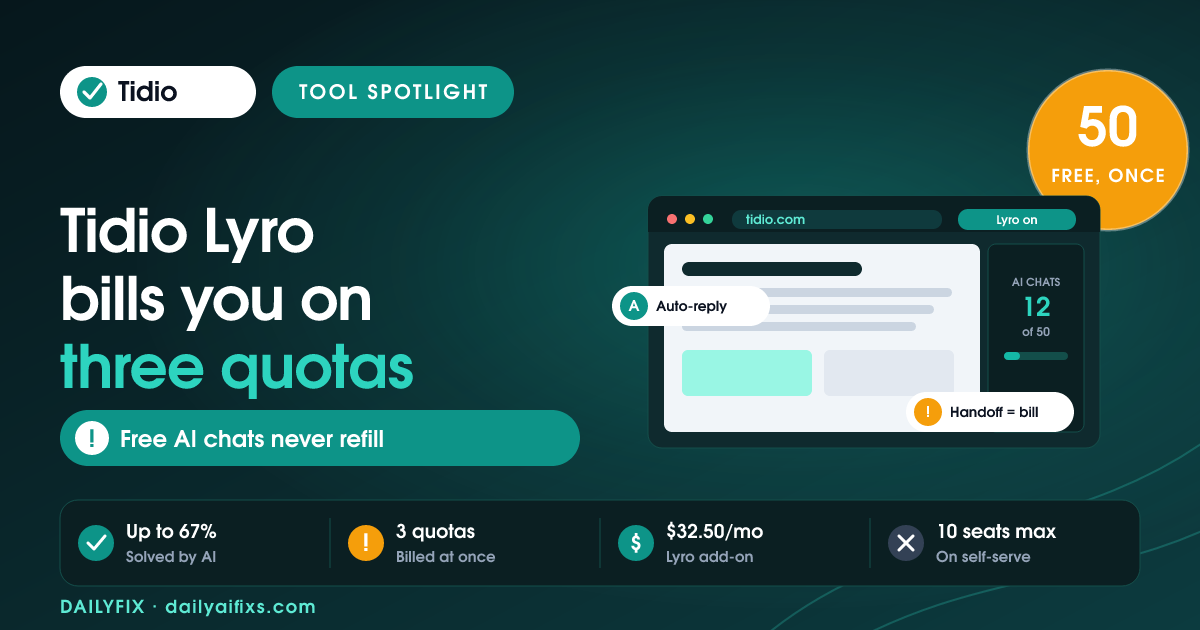
Tidio Lyro pricing in 2026 works on three meters that bill at the same time: billable conversations, Lyro AI conversations, and Flows visitors. The free plan gives 50 billable conversations a month but only 50 Lyro AI conversations one-off, ever. The Lyro AI Agent add-on starts at $32.50 a month on annual billing (about $39 monthly) for 50 AI conversations, stacked on top of a base plan.
Most pricing pages hide the real number in a footnote. Tidio hides it in an architecture. You can read the plan cards, pick Starter, feel good about $29, and still be surprised on the invoice — because the AI you actually signed up for is not in the plan you bought. Here is the whole structure, with figures pulled from Tidio's own pricing page in July 2026.
What is Tidio Lyro?
Tidio Lyro is the AI customer-service agent inside Tidio, a live chat and helpdesk platform for small online businesses. Lyro reads a business's help content and answers customer questions automatically, handing off to a human when it cannot resolve the issue. Tidio's product page claims Lyro solves up to 67% of customer problems. Lyro is sold as an add-on, not as a feature of the base Tidio plans.
Lyro also now exists as a standalone product that can be bolted onto Zendesk, Salesforce or another helpdesk without using Tidio's own inbox. For a solopreneur running a Shopify store or a service site, though, the normal path is Tidio plus the Lyro add-on, and that combination is where the pricing gets confusing.
How much does Tidio Lyro cost in 2026?
The Lyro AI Agent add-on starts at $32.50 per month on annual billing, roughly $39 per month if paid monthly, and that entry price buys 50 Lyro AI conversations a month. Lyro tiers then step through 100, 150, 200, 300, 500, 750 and 1,000 conversations per month. Above 1,000 Lyro conversations, Tidio's pricing page directs you to sales for a custom plan. The add-on price sits on top of whatever base Tidio plan the account is on.
The base plans, as listed on Tidio's pricing page in July 2026 with annual billing selected:
| Plan | Price (annual) | Billable conversations | Lyro AI conversations |
|---|---|---|---|
| Free | $0 | 50 / mo | 50 one-off (lifetime) |
| Starter | $24.17 / mo | 100 / mo | 50 one-off (lifetime) |
| Growth | from $49.17 / mo | from 250 / mo | Add-on only |
| Plus | from $300 / mo + usage | Custom | Custom |
| Premium | Contact sales | Custom | from 3,000 / mo |
| Lyro AI Agent add-on | from $32.50 / mo | — | from 50 / mo |
Prices and limits change often — verify on the official pricing page before deciding.
One note on the Plus plan. Third-party pricing round-ups published earlier in 2026 still quote Plus at $749 per month. Tidio's own pricing page in July 2026 lists Plus as starting at $300 per month plus monthly usage. If you are comparing Tidio against a competitor using a blog post rather than the vendor's page, you may be working from a number Tidio has already moved.
Why does the Tidio free plan run out of AI so fast?
The Tidio free plan runs out of AI fast because its 50 Lyro AI conversations are a one-off lifetime allowance, not a monthly refill. The 50 billable conversations on the free plan do reset every 30 days, which makes the two limits look identical on the plan card when they behave completely differently. Once the 50 Lyro conversations are gone, the AI agent stops answering permanently unless the add-on is bought.
This is the single most common surprise with Tidio Lyro pricing in 2026. A store owner installs Tidio, watches Lyro answer shipping questions beautifully for a week, then finds Lyro silent in week three and assumes the tool broke. It did not break. The lifetime allowance ran out. Tidio's help documentation is clear about it; the plan card is not.
What are the three quotas that bill separately?
Tidio meters three things independently: billable conversations, Lyro AI conversations, and Flows visitors reached. A billable conversation is any live chat, ticket, email or social message thread, whether it was started by a visitor, an operator or an automated flow. A Lyro AI conversation is counted when the Lyro AI agent handles a customer. Flows visitors are counted when an automated no-code flow triggers. One customer interaction can draw down more than one quota.
Here is what that looks like in practice. A visitor lands on your pricing page, a Flow triggers a proactive greeting (Flows quota), Lyro answers two questions about your refund policy (Lyro quota), the visitor asks something Lyro cannot handle and it hands off to you (billable conversation quota). One person, three meters. That is why the headline plan price and the invoice diverge.
The 30-day reset compounds this. Tidio's help centre confirms the Lyro limit refreshes 30 days from the moment payment was taken, not on the first of the calendar month, and on the free plan it refreshes 30 days from account creation. If you plan support capacity against calendar months, your quota will drift a day or two out of alignment every cycle.
What do real users complain about?
The recurring complaint about Tidio is not the per-unit price, it is the surprise. User reports collected across review sites and community threads through 2026 cluster around three issues: automatic plan upgrades taking effect without an obvious confirmation step, bills climbing well above the advertised tier once all three quotas are running, and difficulty getting refunds after an unexpected upgrade. Tidio's late-2024 price restructure is still cited by long-running customers whose monthly cost roughly doubled.
The second structural complaint is the seat ceiling. Every self-service plan — Free, Starter and Growth — caps the account at 10 agent seats. The eleventh seat means moving to Plus. For a solo operator or a three-person team that ceiling is irrelevant, which is worth saying plainly: most DailyFix readers will never hit it.
Is Tidio Lyro worth it for a small business?
Tidio Lyro is worth it if your site already generates more than roughly 50 repetitive support questions a month, because $39 a month is cheaper than the hours those questions eat. Below that volume, the honest answer is no — a clear FAQ page plus Tidio's free live chat does the same work for $0. The break-even is about question volume, not company size.
Our recommendation, based on Tidio's official pricing and documentation plus user reports as of July 2026: start on the Free plan and deliberately spend the 50 lifetime Lyro conversations as a test. Watch how many Lyro actually resolves without handing off to you. Tidio advertises up to 67% resolution, but note that Tidio only guarantees a 50% resolution rate on its top Premium tier — which is a quiet admission that the 67% figure is a ceiling, not a floor. If your own 50-conversation test lands near 50% or better, the add-on will pay for itself. If it lands at 20%, your help content is too thin and no AI agent will fix that.
One thing to set before you spend those 50 free conversations: write or tidy your help content first. Lyro answers from your knowledge base. Turning it on against a three-line FAQ page and then judging the resolution rate is testing your content, not the AI.
Frequently asked questions
Is Tidio's Lyro AI free?
Tidio's Lyro AI is free for exactly 50 conversations, and that allowance is one-off rather than monthly. Once a Tidio account uses those 50 Lyro AI conversations, the AI agent stops replying until the Lyro AI Agent add-on is purchased, which starts at $32.50 per month billed annually for 50 Lyro conversations a month.
How much does Tidio Lyro cost per month in 2026?
The Lyro AI Agent add-on starts at $32.50 per month on annual billing, or roughly $39 per month billed monthly, and that entry price covers 50 Lyro AI conversations per month. Higher Lyro tiers step up through 100, 150, 200, 300, 500, 750 and 1,000 conversations per month, with anything above 1,000 requiring a custom quote from Tidio sales.
What counts as a Lyro AI conversation?
A Lyro AI conversation is counted whenever the Lyro AI agent answers a customer, and it is metered separately from Tidio's billable conversations quota. Tidio defines a billable conversation as any live chat, ticket, email or social message thread started by a visitor, an operator or an automated flow, so one customer can consume two different quotas in a single exchange.
Does the Tidio Lyro limit reset every month?
The Lyro conversation limit resets every 30 days, not on the first of the calendar month. On paid plans the 30-day clock starts from the moment payment is taken, and on the free plan it starts from account creation or from the end of the last paid subscription. Budgeting Lyro usage against a calendar month will therefore be slightly off.
Is Tidio Lyro worth it for a solopreneur?
Tidio Lyro is worth it for a solopreneur whose website already produces more than about 50 repetitive support questions a month, because roughly $39 a month is cheaper than the hours those questions consume. Below that volume, the Lyro AI Agent add-on is hard to justify and a well-written FAQ page plus Tidio's free live chat does the same job for $0.
How many agent seats does Tidio allow?
Tidio's self-service plans — Free, Starter and Growth — cap the account at 10 agent seats. A team that needs an eleventh seat has to move to the Plus plan, which Tidio's pricing page lists as starting at $300 per month plus usage as of July 2026. That seat ceiling is the single biggest jump in the Tidio pricing ladder.
The bottom line
Tidio Lyro is a capable AI support agent priced through a structure that punishes anyone who does not read carefully. The number to remember is not $29 or $39 — it is three, as in three quotas billing simultaneously, one of which never refills on the free plan. Spend the 50 free Lyro conversations as a deliberate test of your own help content, measure the real resolution rate, and only then decide whether the add-on earns its place. If your site fields fewer than 50 repeat questions a month, skip it entirely.
All prices and limits above were taken from Tidio's official pricing page and help centre in July 2026, plus independent review coverage and user reports from the same period. Verify current figures at tidio.com/pricing before purchasing.