Dust Pricing 2026: The Per-Seat Credit Meter
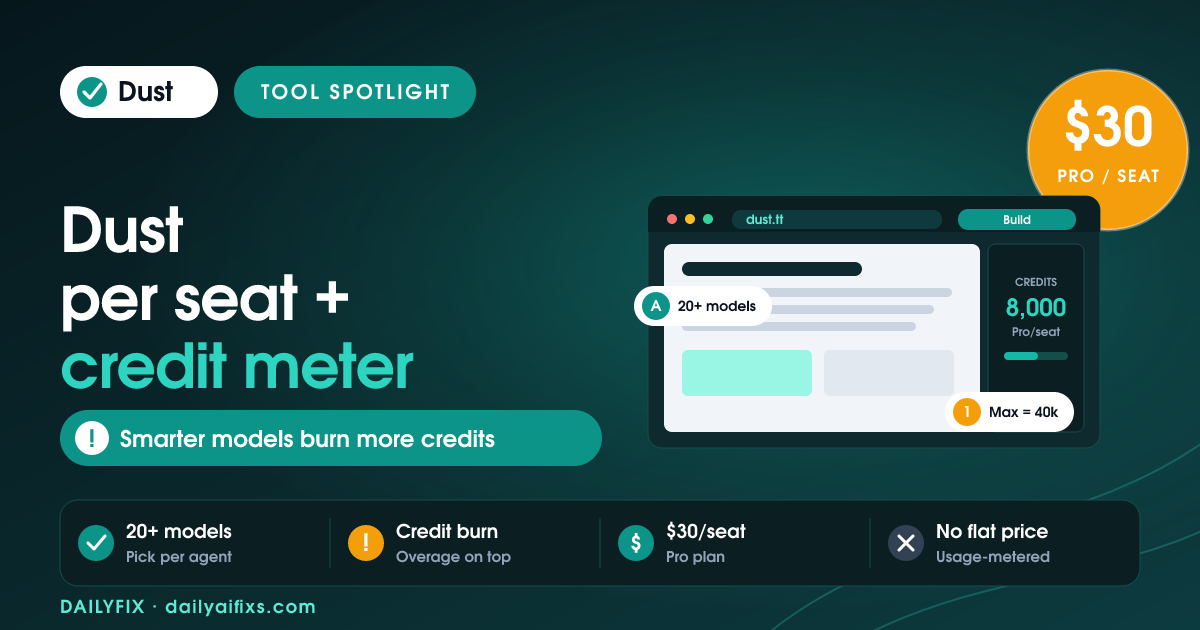
TL;DR: Dust pricing is per seat: Pro is $30/month with 8,000 credits and Max is $150/month with 40,000 credits, plus a 14-day trial and custom Enterprise. The catch: credits are a usage meter, and higher-capability models burn them faster, with overages billed on top. Your real bill is the seat fee plus whatever credits your agents consume.
Last updated: August 2026 · By Sandeep Singh, DailyFix
Dust is one of the most popular platforms for building AI agents grounded in a team's own knowledge, connecting tools like Notion, Slack, Drive and GitHub to assistants that people use every day. As of August 2026, its pricing looks like a simple per-seat SaaS ladder. The detail that shapes the real bill is the credit pool attached to each seat, and the fact that the smarter the model you pick, the faster it drains.
What are the Dust pricing plans in 2026?
Dust has two self-serve per-seat plans plus Enterprise: Pro at $30/month ($24 billed yearly) with 8,000 credits per seat, and Max at $150/month ($120 yearly) with 40,000 credits per seat. According to Dust's pricing and independent breakdowns (checked August 2026), a 14-day free trial precedes them, and every seat includes connectors and access to 20-plus models.
For a solo builder or small team, Pro is the natural starting point and Max is for heavy, everyday agent use. Because you can mix seat types in one workspace and reassign them, a common setup is a couple of Max seats for power users and Pro seats for everyone else, which keeps the credit budget aligned with who actually runs agents hardest.
What does the Dust free trial include?
Dust offers a 14-day free trial rather than a permanent free plan, letting you build agents, connect data sources and test the platform before you pay. It is a full-feature evaluation window, not an ongoing free tier.
That shape rewards a focused test. Rather than dabbling, use the two weeks to wire up one real workflow, connect the data sources you actually use, and confirm the agents produce useful answers grounded in your content. If it earns its place in your day within the trial, upgrading to Pro is an easy call; if not, you have lost nothing but time.
How do Dust credits work?
Dust credits are the usage meter for running agents, and each seat carries a monthly pool: 8,000 on Pro and 40,000 on Max. Every agent message consumes credits, and higher-capability models consume more per message. Once the pool is empty, overage credits bill separately, on top of the seat fee.
This is the per-seat credit meter in practice. Two teammates on the same plan can cost very differently depending on how often they run agents and which models they choose. The lever you control is model choice: use a lightweight model for routine questions and reserve a top-tier model for the tasks that need it. Doing that keeps most of your work inside the included pool and avoids surprise overage.
Dust Pro vs Max: which should you choose?
Choose Dust Pro at $30 for light-to-moderate agent use, since 8,000 credits a month suits regular but not constant usage. Choose Max at $150 if you run agents all day or rely on premium models, because 40,000 credits give five times the headroom before overage kicks in.
The decision comes down to credit burn, not features, because both tiers unlock the same models and connectors. A practical rule: start on Pro, watch your credit consumption for a month, and upgrade the specific heavy users to Max rather than moving everyone. Since seats are mix-and-match and reassignable, you can tune the balance as usage settles instead of over-buying up front.
Dust vs Relevance AI: which is better for agents?
Dust is strong for grounding agents in company knowledge across Notion, Slack, Drive and GitHub with simple per-seat pricing, while Relevance AI leans toward building and orchestrating multi-agent workflows and tools. For a knowledge-grounded team assistant, Dust fits; for automated multi-step agent pipelines, Relevance AI is often the better shape.
Both platforms meter usage on top of their base price, so the choice is about the job, not just the sticker. If your goal is a company brain your team queries all day, Dust's connector-first design and flat per-seat model are easy to reason about. If you are chaining agents to run processes end to end, Relevance AI's orchestration is more purpose-built. Match the tool to whether you want answers or automation.
Dust plan comparison (2026)
| Plan | Price / seat | Monthly credits | Best for |
|---|---|---|---|
| Free trial | $0 (14 days) | Evaluation | Testing one workflow |
| Pro | $30/mo ($24 yearly) | 8,000 | Light-to-moderate use |
| Max | $150/mo ($120 yearly) | 40,000 | Heavy or premium-model use |
| Enterprise | Custom | Custom | Security, scale, support |
Credit overages bill separately; premium models cost more credits per message. Prices and limits change often — verify on the official pricing page before deciding.
Frequently asked questions
Does Dust have a free plan?
Dust offers a 14-day free trial rather than a permanent free plan. The trial lets you build agents, connect data sources and test the platform before paying. After it ends you move to a paid per-seat plan, Pro at $30 per month or Max at $150 per month, or a custom Enterprise agreement for larger teams.
How much does Dust cost per month?
Dust is priced per seat as of August 2026: Pro is $30 per month, or $24 billed yearly, with 8,000 credits per month, and Max is $150 per month, or $120 yearly, with 40,000 credits per month. Enterprise is custom. Each seat includes connectors and access to 20-plus models, with credit overages billed separately.
What are Dust credits?
Dust credits are the usage meter for running agents, and each seat comes with a monthly pool: 8,000 on Pro and 40,000 on Max. Every agent message consumes credits, and higher-capability models consume more per message. When you exhaust the pool, overage credits are billed separately, so your real cost is the seat fee plus any overage.
Should I choose Dust Pro or Max?
Choose Dust Pro at $30 if your agent use is light to moderate, since 8,000 credits a month covers regular but not heavy usage. Choose Max at $150 if you run agents constantly or lean on top-tier models that burn credits faster, because its 40,000 credits give five times the headroom. You can mix seat types across a workspace and reassign them.
Which models does Dust include?
Dust includes access to 20-plus models from OpenAI, Anthropic, Google, Mistral and DeepSeek, and you pick the model per agent. No model is locked behind a higher plan, but more capable models consume more credits per message. That flexibility lets you use a cheap model for simple tasks and a powerful one only where it matters, to control credit burn.
Is Dust better than Relevance AI?
Dust is strong for connecting company knowledge (Notion, Slack, Drive, GitHub) to agents your team uses daily, with simple per-seat pricing. Relevance AI leans toward building and orchestrating multi-agent workflows and tools. For a knowledge-grounded assistant across your stack, Dust fits; for automated multi-step agent pipelines, Relevance AI is often the better shape. Both meter usage on top of the base price.
Who should not use Dust?
Skip Dust if you want a flat, unmetered price, since credits mean heavy usage or premium models add overage cost. It is also more than a solo user needs for a single simple chatbot, where a cheaper single-purpose tool works. Dust shines when a team needs agents grounded in shared company data, not for one-off lightweight bots.
Bottom line
Dust is one of the best ways to give a team AI agents grounded in its own knowledge, and the per-seat pricing is refreshingly clear. Use the 14-day trial to prove one workflow, start on Pro at $30, and upgrade only your heaviest users to Max at $150 rather than everyone. The rule that keeps costs sane: credits are a real meter, and model choice is your lever, so use cheap models for routine work and premium ones only where they earn it. Watch the per-seat credit pool and Dust is strong value for a knowledge-driven team.
Sources
- Dust official pricing page (checked August 2026)
- Automation Atlas — Dust pricing explained, 2026
Related reads
- Relevance AI Pricing 2026: The Dual-Meter Catch
- Lindy AI Pricing 2026: The Usage-Meter Catch
- CrewAI Pricing 2026: Free or Enterprise
- Botpress Pricing 2026: The AI Spend Catch
- Genspark Pricing 2026: The Credit-Burn Catch