Gladia Pricing 2026: The Real-Time Premium
TL;DR: Gladia pricing on the pay-as-you-go Starter plan is $0.61 per hour for async transcription and $0.75 per hour for real-time, with 50 EUR in one-time free credits. The catch: real-time, which voice agents actually need, costs more than async, and the advertised cheap rate of $0.20 per hour only comes with an upfront Growth commitment.
Last updated: August 2026 · By Sandeep Singh, DailyFix
Gladia is a fast-growing speech-to-text API that a lot of voice-agent and meeting-assistant builders lean on, and in 2026 it shipped its Solaria-3 model claiming 9.6% word error rate on real English audio. The pricing page looks refreshingly clear, but if you build live voice agents there is one number that matters more than the one you probably read first. Here is the real math, checked in August 2026.
How does Gladia pricing work in 2026?
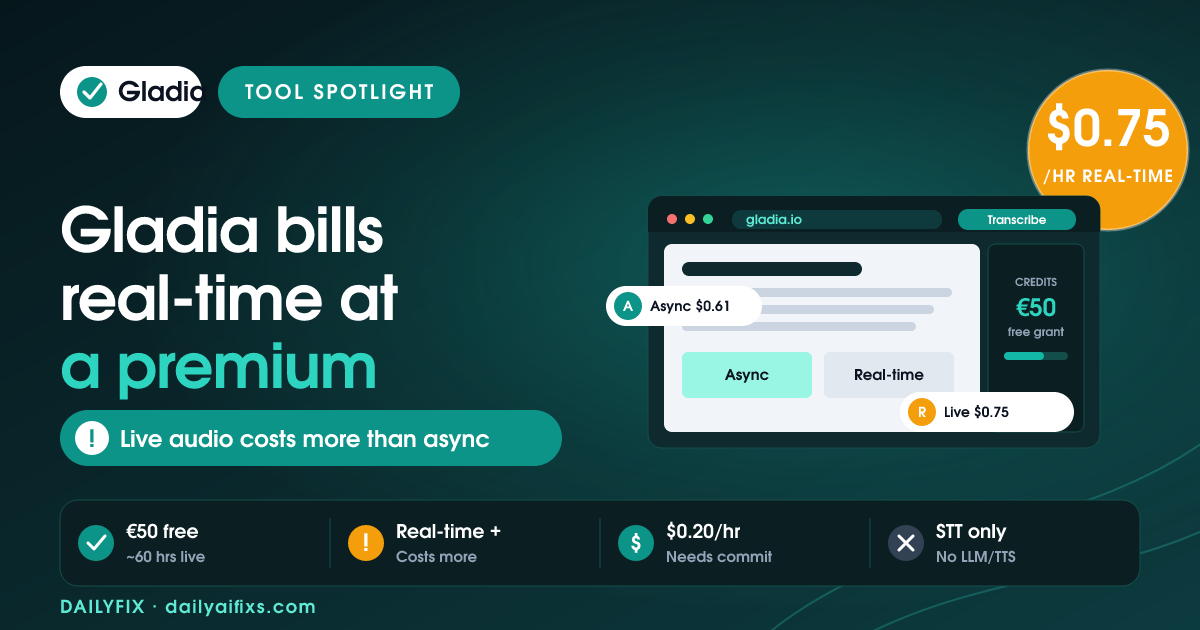
Gladia pricing is usage-based and billed per hour of audio from a prepaid credit wallet, with three tiers: Starter, Growth, and Enterprise. As of August 2026, Starter is pay-as-you-go at $0.61 per hour async and $0.75 per hour real-time, Growth commits upfront for lower rates, and Enterprise is custom, per Gladia's pricing page.
You load credits into a wallet and draw them down as you transcribe, with optional auto top-up when the balance runs low. That means no monthly invoice surprise, but it also means you pay per hour of audio processed, split into two meters: async (batch processing recorded files) and real-time (live streaming). Which meter you use decides your bill, and for voice agents it is always the pricier one.
How much does Gladia cost per hour?
Gladia costs $0.61 per hour for async transcription and $0.75 per hour for real-time on the Starter plan, according to Gladia's pricing page checked in August 2026. The Growth plan drops those to as low as $0.20 async and $0.25 real-time, a cut of up to 67%, but only with an upfront commitment and a sales conversation.
This is the first catch. The eye-catching "as low as $0.20 per hour" figure is a Growth-plan rate that requires committing spend in advance; the price you actually pay on day one, self-serve, is $0.61 or $0.75. For a solo builder transcribing, say, 200 hours of real-time audio a month, Starter runs about $150 a month, while a committed Growth rate near $0.25 would be about $50, a real gap, but one gated behind a commitment you may not want early on.
| Plan | Async / hr | Real-time / hr | Free credits | Commitment |
|---|---|---|---|---|
| Starter | $0.61 | $0.75 | 50 EUR one-time | None, pay-as-you-go |
| Growth | from $0.20 | from $0.25 | — | Upfront commit |
| Enterprise | Custom | Custom | — | Annual, custom |
Prices and limits change often — verify on the official pricing page before deciding.
Is the Gladia free credit enough to test?
Gladia's 50 EUR in free credits is a one-time grant, not a monthly reset, and it stretches to roughly 80-plus hours of async transcription or 60-plus hours of real-time at current rates. That is more than enough to benchmark accuracy, test diarization, and wire Gladia into a prototype voice agent before spending anything.
Because the free credits do not refill each month, treat them as a runway, not a recurring allowance. A meeting-assistant side project processing a few hours a week can coast on the grant for a while; a live phone agent handling real call volume will burn through 60 real-time hours quickly. The smart move is to use the free credits to measure your true hours-per-month, then decide whether Starter's pay-as-you-go rate is fine or whether your volume justifies a Growth commitment.
Why does Gladia real-time cost more than async?
Gladia real-time costs more than async, $0.75 versus $0.61 per hour on Starter, because streaming holds a live connection with sub-300ms latency, which uses more compute than batch-processing a finished recording. Voice agents require real-time, so they always land on the higher meter.
This is the detail that catches voice-agent builders. If you read the pricing quickly and anchor on the async rate, you underestimate your bill, because a live phone or web agent streams audio and bills at the real-time rate every minute the caller is speaking. Async is for after-the-fact work like transcribing recorded meetings, podcasts, or call archives. Map your use case to the right meter before you forecast costs: transcribing recordings is cheap, powering a live conversation costs about 23% more per hour on Starter.
Is Gladia good for voice agents?
Gladia for voice agents is a strong speech-to-text choice: real-time streaming under 300ms, speaker diarization, word-level timestamps, and 100-plus languages, with a dedicated voice-agents use case. But Gladia is the transcription layer only, so its per-hour price is one line item, not the whole bill.
A working voice agent also needs a language model to decide what to say and a text-to-speech engine plus telephony to say it. Gladia handles the "hearing" at $0.75 an hour on Starter; the "thinking" and "speaking" are separate costs on top. For a solopreneur, that is fine as long as you price the full stack. Gladia's accuracy and clear per-hour meter make it easy to reason about, which is exactly why it fits builders who want transcription they can budget without surprises.
Frequently asked questions
Can I try Gladia for free?
Yes. Gladia gives new accounts 50 EUR in free credits, a one-time grant with no monthly reset. At current rates that is roughly 80-plus hours of pre-recorded transcription or 60-plus hours of real-time transcription. Once the credits are used, you top up your prepaid wallet or move to a committed plan to keep going.
How much does Gladia cost per hour?
On the pay-as-you-go Starter plan, Gladia costs $0.61 per hour for async transcription and $0.75 per hour for real-time transcription, per Gladia's pricing page checked in August 2026. The Growth plan lowers those to as little as $0.20 async and $0.25 real-time, but only with an upfront commitment.
Why does Gladia real-time cost more than async?
Real-time streaming holds a live connection with sub-300ms latency, which uses more compute than batch processing a finished file. So Gladia prices real-time at $0.75 per hour versus $0.61 for async on Starter. Voice agents need real-time, so they pay the higher rate.
How is Gladia billed?
Gladia runs on a prepaid credit wallet. You top up manually or set auto top-up to refill when your balance drops below a threshold you choose. You get alerts on low balance and top-ups, so there are no end-of-month invoices. Enterprise plans can pay by bank transfer or invoicing.
What is the difference between Gladia Starter and Growth?
Starter is pay-as-you-go at $0.61 async and $0.75 real-time per hour with 50 EUR free credits and fixed concurrency. Growth cuts unit prices by up to 67%, to about $0.20 async and $0.25 real-time, and adds flexible concurrency and volume discounts, but it requires an upfront commitment and a sales conversation.
Is Gladia good for voice agents?
Yes, Gladia is built for voice agents, with real-time streaming under 300ms, speaker diarization, and 100-plus languages. Budget the real-time rate, not the cheaper async rate, because live agents stream audio. On Starter that is $0.75 per hour of speech-to-text, before you add the language model and telephony.
Bottom Line
Gladia is one of the clearest-priced, most accurate speech-to-text APIs in 2026, and its 50 EUR free credits make it easy to benchmark before you pay. Use Starter's pay-as-you-go rate while your volume is small, and budget the $0.75 real-time meter if you build live voice agents, not the cheaper async number. Move to Growth only once your monthly hours are high enough to justify committing spend. Skip Gladia only if you need an all-in-one agent platform rather than a transcription layer.
Sources
- Gladia — Official pricing (checked August 2026)
- Gladia — Documentation
Related reads
- Deepgram Pricing 2026: The Sub-Cent Myth
- AssemblyAI Pricing 2026: The Per-Hour Truth
- Rime AI Pricing 2026: The Per-Character Catch
- Cartesia Pricing 2026: The Two-Wallet Catch
- ElevenLabs Pricing 2026: Is the Free Plan Enough?