AssemblyAI Pricing 2026: The Per-Hour Truth
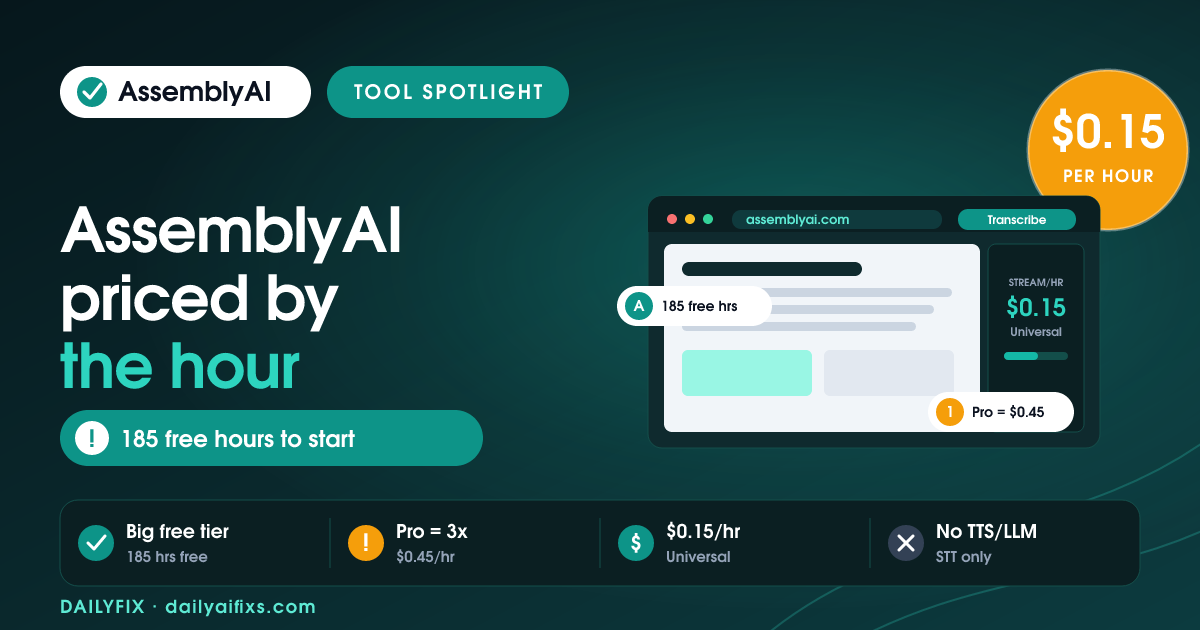
TL;DR: AssemblyAI pricing is pure pay-as-you-go by the hour, with no monthly tiers. As of August 2026, Universal streaming speech-to-text is $0.15 per hour and Universal-3.5 Pro realtime is $0.45 per hour, and the free tier covers up to 185 hours pre-recorded and 333 hours streaming. Audio intelligence add-ons bill on top, so watch your effective rate.
Last updated: August 2026 · By Sandeep Singh, DailyFix
AssemblyAI is one of the most trusted speech-to-text APIs behind voice agents, call analytics and transcription products, valued for accuracy and a developer-friendly API. As of August 2026, its pricing is refreshingly simple on the surface: pay per hour, no plan ladder. The truth worth knowing is which model you are calling and which add-ons are switched on, because those decide whether you pay the headline $0.15 or several times that.
What are the AssemblyAI pricing plans in 2026?
AssemblyAI does not use monthly plan tiers; its self-serve pricing is pay-as-you-go by the hour of audio, plus a free allowance and custom Enterprise. According to AssemblyAI's pricing page (checked August 2026), Universal streaming is $0.15 per hour, Universal-3.5 Pro realtime is $0.45 per hour, and the Sync API for short-form audio, launched July 2026, is $0.45 per hour.
This model suits builders because there is nothing to commit to. You are billed for exactly the audio you process, at the rate of the model you choose. For a solo developer or agency, that means a quiet month costs almost nothing and a busy month scales linearly, with Enterprise available once volume justifies a committed, discounted contract.
What does the AssemblyAI free tier include?
The AssemblyAI free tier requires no credit card and covers up to 185 hours of pre-recorded transcription and up to 333 hours of streaming transcription. You can sign up and start transcribing immediately, which makes it one of the most generous free allowances in the speech-to-text market.
That headroom is a real advantage for freelancers. You can build a client's transcription or voice-agent proof of concept, run genuine test traffic, and demo it working, all before spending a rupee or a dollar. The free hours draw down as you use them, so treat them as a launch runway: prove the product, sign the client, then flip to pay-as-you-go for production volume.
What does AssemblyAI streaming cost per hour?
AssemblyAI streaming speech-to-text costs $0.15 per hour on the Universal model and $0.45 per hour on Universal-3.5 Pro realtime, per AssemblyAI's pricing page (checked August 2026). Streaming is the mode voice agents use, because it transcribes audio live as the caller speaks rather than after the fact.
Do the quick math before you build: $0.15 per hour is $0.0025 per minute, so a thousand minutes of live transcription is about $2.50 on Universal. Switch to Pro and the same thousand minutes is roughly $7.50. That three-times gap is the single biggest lever on your transcription bill, so pick Pro only where accuracy genuinely pays for itself.
AssemblyAI vs Deepgram pricing: which is cheaper?
AssemblyAI and Deepgram are close rivals: Deepgram's Nova-3 streaming is often cheaper per minute, while AssemblyAI offers a more generous free tier and strong accuracy. AssemblyAI bills by the hour and Deepgram by the minute, so convert both to the same unit before comparing, or the numbers mislead you.
The honest verdict: at steady production volume, Deepgram's per-minute streaming rate frequently edges out AssemblyAI on raw transcription cost. AssemblyAI wins on free-tier headroom, ease of onboarding and its audio-intelligence suite. Many builders prototype on AssemblyAI's generous free hours, then compare the two at their real volume, since the cheaper option flips depending on the models and add-ons you actually use.
AssemblyAI rate comparison (2026)
| What you use | Rate | Notes |
|---|---|---|
| Universal streaming STT | $0.15/hr | ~$0.0025/min, standard real-time |
| Universal-3.5 Pro realtime | $0.45/hr | Higher accuracy, 3x the price |
| Sync API (short-form) | $0.45/hr | Launched July 2026 |
| Free tier | $0 | Up to 185 hrs pre-recorded, 333 hrs streaming |
| Audio intelligence add-ons | On top | Summaries, sentiment, speaker labels |
Prices and limits change often — verify on the official pricing page before deciding.
Frequently asked questions
Is AssemblyAI free to use?
Yes. AssemblyAI has a free tier with no credit card required, covering up to 185 hours of pre-recorded transcription and up to 333 hours of streaming transcription. You can create an account and start transcribing immediately. It is one of the most generous free allowances in speech-to-text, enough to build and test a real product before paying.
How much does AssemblyAI cost per hour?
AssemblyAI charges pay-as-you-go by the hour of audio. As of August 2026, Universal streaming speech-to-text is $0.15 per hour and Universal-3.5 Pro realtime is $0.45 per hour. The Sync API for rapid short-form transcription, launched July 2026, is also $0.45 per hour. There are no monthly plan tiers; you pay for what you process.
Does AssemblyAI have monthly plans?
No. AssemblyAI uses pure pay-as-you-go pricing rather than monthly subscription tiers for its self-serve product. You add funds or a card and are billed per hour of audio processed, per model. Enterprise customers can contact sales for a custom plan with volume discounts, committed pricing and dedicated support, but there is no fixed monthly ladder.
What is the difference between Universal and Pro on AssemblyAI?
AssemblyAI's Universal streaming is the standard real-time model at $0.15 per hour, while Universal-3.5 Pro realtime is the higher-accuracy model at $0.45 per hour, three times the price. Pro is worth it when transcription accuracy directly affects your product, such as medical or legal audio; Universal is fine for most voice agents and general transcription.
Is AssemblyAI cheaper than Deepgram?
For streaming, Deepgram's Nova-3 is cheaper per minute than AssemblyAI's Universal at typical rates, but AssemblyAI's free tier is more generous and its accuracy is highly rated. AssemblyAI charges by the hour and Deepgram by the minute, so convert to the same unit before comparing. Neither is universally cheaper; it depends on volume and which model you use.
Does AssemblyAI charge for audio intelligence features?
Yes. Beyond core transcription, AssemblyAI's audio intelligence features such as summarization, sentiment analysis and speaker labels are billed on top of the base transcription rate. If you enable several add-ons, your effective per-hour cost rises above the headline $0.15. Turn on only the features you need to keep the bill close to the base rate.
Who should not use AssemblyAI?
Skip AssemblyAI if you want an all-in-one bundled voice agent with built-in text-to-speech and an LLM, since AssemblyAI focuses on speech-to-text and audio intelligence, not a full agent stack. For a complete talking agent you would pair it with a separate text-to-speech and LLM, or use a bundled platform instead.
Bottom line
AssemblyAI is a top choice when accurate speech-to-text is central to your product, and its 185 free hours make it painless to prototype and demo before paying. Stay on Universal at $0.15 per hour for most work, and reserve Pro at $0.45 for audio where accuracy genuinely pays for itself. Watch two things: which model you call, and which audio-intelligence add-ons are switched on, because both push your effective rate above the headline. For pure transcription at volume, compare it against Deepgram; for ease and free headroom, AssemblyAI is hard to beat.
Sources
- AssemblyAI official pricing page (checked August 2026)
- Gladia — AssemblyAI pricing analysis, 2026
Related reads
- Deepgram Pricing 2026: The Sub-Cent Myth
- Cartesia Pricing 2026: The Two-Wallet Catch
- LiveKit Pricing 2026: The Agent-Minute Catch
- Vapi Pricing 2026: The Real Cost Per Minute
- ElevenLabs Pricing 2026: The Commercial Catch