Firecrawl Pricing 2026: The Annual-Billing Catch
TL;DR: Firecrawl pricing starts free with 1,000 credits a month, then runs $16 Hobby, $83 Standard, and $333 Growth. The catch: those headline prices are billed yearly, and on every self-serve plan the credits reset monthly with no rollover. You pay 1 credit per page scraped, but advanced extraction costs extra.
Last updated: August 2026 · By Sandeep Singh, DailyFix
Firecrawl is one of the most talked-about tools for turning web pages into clean Markdown that AI agents and RAG pipelines can actually use. As of August 2026 it has crossed 160,000 GitHub stars, so plenty of solo builders are wiring it in. The pricing looks simple on the surface, but a couple of details decide whether your bill matches the sticker. Here is the real math, checked in August 2026.
How does Firecrawl pricing work in 2026?
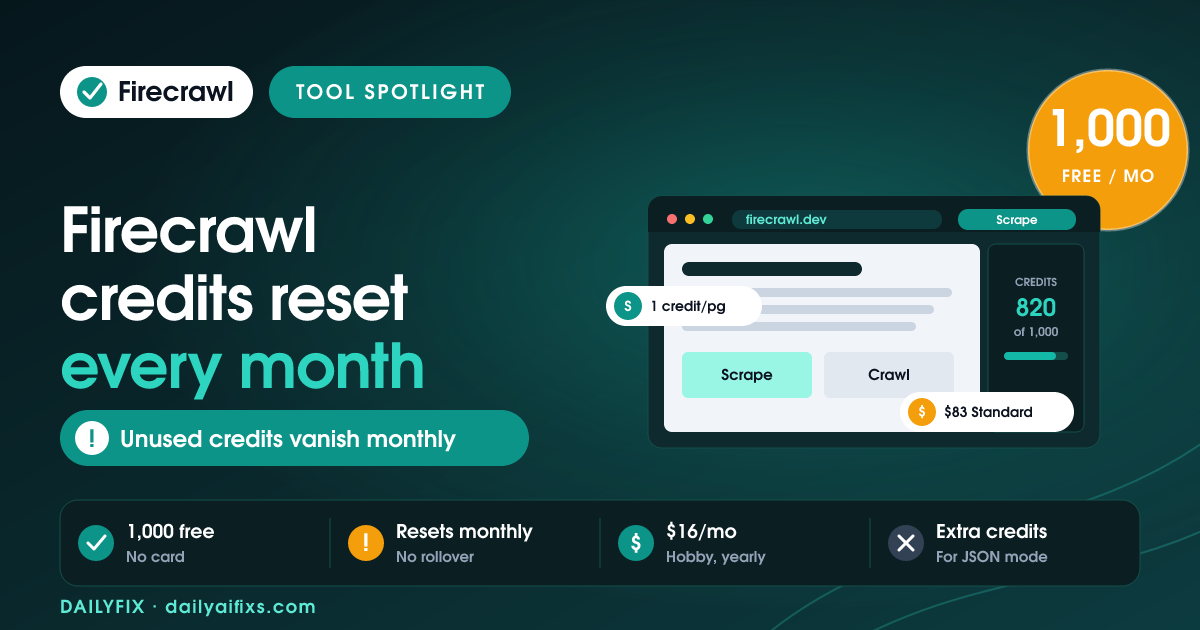
Firecrawl pricing is credit-based and sold in monthly subscription tiers, not pay-as-you-go. Every account gets 1,000 free credits a month, and paid self-serve plans run $16 Hobby, $83 Standard, and $333 Growth, each billed yearly, with a $599 Scale plan above them, per Firecrawl's pricing page checked in August 2026.
Each plan buys a monthly pool of credits, and one credit roughly equals one scraped page. The first catch is billing cadence: the advertised $16, $83, and $333 rates assume annual prepayment, so month-to-month billing costs more. The second is that Firecrawl confirms there is no pay-per-use option, only these fixed monthly buckets. Pick a tier that matches your expected page volume, because you commit to the whole pool whether you use it or not.
How many credits does a Firecrawl scrape cost?
A Firecrawl scrape costs 1 credit per page, and so do crawl, map, and monitor requests. Search costs 2 credits per 10 results, and browser interaction costs 2 credits per browser minute, according to Firecrawl's credits table checked in August 2026. Advanced features add more on top.
That flat "1 credit per page" number is where estimates go wrong. Firecrawl notes that advanced features, such as JSON-format structured extraction and Enhanced Mode, cost additional credits per page. If your agent pulls structured data instead of raw Markdown, real consumption climbs above one credit per page. There is one more line to know: Firecrawl does not charge for failures on its side, but it does charge when a page loads successfully even if the site returns a 4xx or 5xx error. A broken page that still responds costs you a credit.
| Plan | Price (billed yearly) | Pages / month | Concurrency | Credit rollover |
|---|---|---|---|---|
| Free | $0 | 1,000 | 2 | No |
| Hobby | $16/mo | 5,000 | 5 | No |
| Standard | $83/mo | 100,000 | 50 | No |
| Growth | $333/mo | 500,000 | 100 | No |
| Scale | $599/mo | 1,000,000 | 150 | Yes |
Prices and limits change often — verify on the official pricing page before deciding.
Is the Firecrawl free plan enough for a real project?
The Firecrawl free plan gives 1,000 credits a month, about 1,000 pages, with no credit card, but it caps you at 2 concurrent requests and low rate limits. That is enough to build and test a small agent or RAG index, not enough to run a production crawler that refreshes thousands of pages.
The free tier is best treated as a trial that never fully expires: you can keep a light, low-volume tool running on it indefinitely, as long as you stay under 1,000 pages a month and can live with slow throughput. The moment you need speed, more pages, or scheduled monitoring across a real site, the 2-concurrent-request ceiling forces you onto Hobby or Standard. For most solopreneurs validating an idea, though, 1,000 free pages a month is plenty to prove the pipeline works before spending anything.
Do Firecrawl credits roll over each month?
No. Firecrawl credits do not roll over on the Free, Hobby, Standard, or Growth plans, so any credits you do not use in a month are gone. Rollover is only offered on the Scale and Enterprise plans, per Firecrawl's pricing FAQ checked in August 2026.
This is the quiet cost of the annual-billing model. If you prepay for a Standard plan's 100,000 pages a month but your workload is spiky, running heavy some weeks and idle others, you still lose the unused credits at each monthly reset. There is no banking a slow month to cover a busy one unless you are on Scale. For bursty workloads, that pushes you either to over-buy a bigger monthly pool or to accept paying for capacity you never touch. Map your real monthly pattern before committing to a year.
Is Firecrawl worth it for AI agents and RAG?
Firecrawl for AI agents is worth it when you want clean, structured web content without building and maintaining your own scraper. It turns any URL into agent-ready Markdown or JSON, and it plugs into the usual agent stacks, which is exactly why so many builders reach for it in 2026.
The honest trade-off is cost predictability, not capability. The tool itself is strong; the surprises come from the billing model, monthly credit resets, annual prepay to get the sticker price, and extra credits for structured extraction. For a solo builder, the smart play is to run on the free tier while prototyping, measure exactly how many pages and how much structured extraction your agent actually needs per month, then buy the smallest plan that covers it. Do that, and Firecrawl is one of the cleanest ways to feed real web data into an AI agent.
Frequently asked questions
Is Firecrawl free?
Yes, partly. Firecrawl gives every account 1,000 free credits per month, enough to scrape about 1,000 pages, with no credit card required. The free tier caps you at 2 concurrent requests and low rate limits, and the credits do not roll over. It is enough to prototype an agent or a small RAG pipeline before you pay.
How much does a Firecrawl scrape cost in credits?
A scrape, crawl, map, or monitor request costs 1 credit per page on Firecrawl. Search costs 2 credits per 10 results, and browser interaction costs 2 credits per browser minute. Advanced features like JSON extraction and Enhanced Mode consume extra credits, so real usage runs higher than the flat 1-credit-per-page headline.
Are Firecrawl's listed prices monthly or yearly?
The headline prices on Firecrawl's pricing page, $16 Hobby, $83 Standard, and $333 Growth, are billed yearly. Paying month to month costs more per month. The annual commitment is what unlocks the advertised rate, so the sticker price assumes you prepay for a year.
Do Firecrawl credits roll over?
No, not on self-serve plans. Firecrawl credits reset every month on the Free, Hobby, Standard, and Growth plans, so anything unused is lost. Credit rollover is only available on the higher Scale and Enterprise plans, per Firecrawl's pricing FAQ checked in August 2026.
Does Firecrawl charge for failed requests?
Firecrawl does not charge when the failure is on its side, such as a timeout or server error. It does charge when a page is fetched successfully, even if the target site returns a 4xx or 5xx status code. So a page that loads but shows an error page still costs a credit.
Is Firecrawl good for solo builders?
For a solo builder feeding a RAG system or an AI agent, Firecrawl's free 1,000 credits and $16 Hobby plan are an easy, low-risk start. The main watch-outs are monthly credit resets and extra credits for advanced extraction. Estimate your monthly page volume first, because paying yearly locks you in.
Bottom Line
Firecrawl is one of the best tools in 2026 for turning web pages into clean, agent-ready data, and its free 1,000 credits a month make it easy to try with zero risk. Buy Hobby or Standard once you know your real monthly page volume, and lean on it if you build AI agents or RAG pipelines. Just go in knowing the sticker prices are annual and credits reset every month. If your workload is bursty or you refuse annual prepay, price that in before you commit.
Sources
- Firecrawl — Official pricing and credits table (checked August 2026)
- Firecrawl — Documentation
Related reads
- Apify Pricing 2026: The Compute Unit Catch
- Browse AI Pricing 2026: The Credit Reset Catch
- Octoparse Pricing 2026: The Add-On Credit Catch
- PhantomBuster Pricing 2026: The Execution-Time Catch
- Clay Pricing 2026: Two Credit Currencies