Flowise Pricing 2026: The Hidden Stack Cost
TL;DR: Flowise pricing looks cheap: open-source and self-hostable for free, or Cloud from $35/month (Starter) and $65/month (Pro). The catch: the subscription is the smallest line. LLM tokens, a vector database and connected APIs bill separately, pushing real monthly spend to roughly $105-200 once everything is combined.
Last updated: August 2026 · By Sandeep Singh, DailyFix
Flowise is one of the most popular open-source, low-code builders for LLM apps and AI agents, giving you a visual canvas for chains, retrieval and assistants. As of August 2026, its pricing headline is genuinely attractive: free to self-host, cheap in the cloud. The truth worth internalizing before you commit is that the Flowise fee is the smallest part of running a real agent, and the bills you do not see on the pricing page decide your budget.
What are the Flowise pricing plans in 2026?
Flowise is open-source and self-hostable for free, and Flowise Cloud adds a free tier plus Starter at $35/month and Pro at $65/month, with custom Enterprise. According to Flowise's pricing and independent breakdowns (checked August 2026), Starter includes 10,000 predictions and 1GB storage, while Pro includes 50,000 predictions, 10GB and team collaboration.
For a solo developer, self-hosting or the $35 Starter cloud plan is the usual entry point, and Pro at $65 is the step up when you need more predictions or teammates. But the plan you pick is only one dimension of cost; the models and data infrastructure behind your flows matter more to the final bill, which is where builders get surprised.
Is Flowise free?
Flowise is free in two senses: the open-source version is free to self-host, and Flowise Cloud has a free tier with 2 flows, 100 predictions per month and 5MB of storage. Both are real, but both have limits, so "free" means "free to start," not "free to run in production."
Self-hosting removes the subscription but not the cost: you still pay for a server to run it and for the model and database usage your flows generate. The cloud free tier's 100 predictions vanish in testing. Use free to learn the tool and prototype one flow, then decide between the cloud Starter plan and a self-hosted setup based on your volume and appetite for maintenance.
What does the Flowise Starter plan cost?
The Flowise Cloud Starter plan costs $35 per month and includes 10,000 predictions and 1GB of storage, with limits on the number of chatflows. A prediction is one run of a flow, so 10,000 covers light-to-moderate traffic before you need Pro at $65 per month with 50,000 predictions.
At $35, Starter is cheap for what the platform does, and for many small agents it is enough. The mistake is reading that number as your total. Every prediction that calls an LLM also spends model tokens billed by OpenAI, Anthropic or whoever you use, and retrieval flows hit a vector database. The subscription buys the builder and hosting; it does not cover the intelligence.
What are the hidden costs of Flowise?
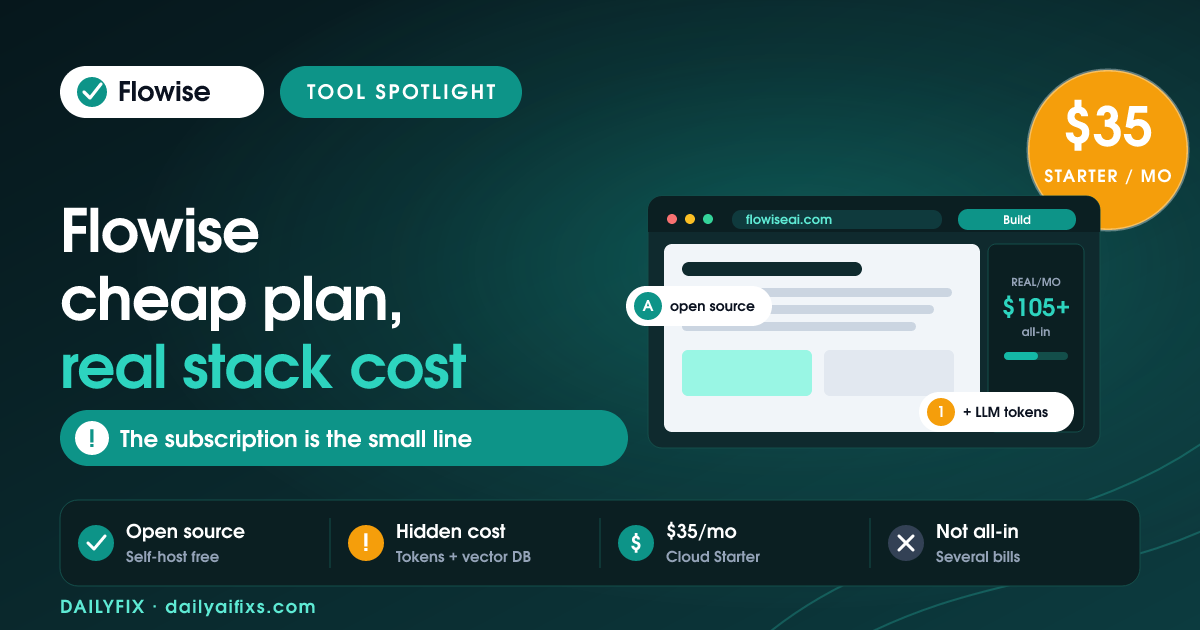
The hidden costs of Flowise are LLM tokens, a vector database and any external APIs, all billed outside your subscription. In practice, expect roughly $105 to $200 a month once you combine the $35 Starter plan, $25 to $90 in model tokens depending on which models you use, and $45 to $75 for a vector database if you run retrieval-augmented generation.
This is the hidden stack cost in numbers, and it flips the story. The Flowise fee is often the smallest line on the bill, while model choice is the biggest variable. To control it, pick cheaper models for routine steps, cache where you can, and only stand up a paid vector database when your app genuinely needs retrieval. Budget the whole stack, not just the plan, before quoting a client.
Flowise vs n8n: which for AI agents?
Flowise is purpose-built for LLM apps and agents, with a visual canvas for chains, retrieval and assistants, while n8n is a broader automation platform with AI nodes bolted on. For a dedicated agent or chatbot builder, Flowise is more focused; for general automation that also uses AI, n8n is more versatile. Both are open-source and self-hostable.
The practical choice depends on the center of gravity of your project. If the app is fundamentally an AI assistant with memory and retrieval, Flowise's LLM-first design fits better. If AI is one step inside a larger workflow that moves data between many apps, n8n's automation breadth wins. Because both self-host, the deciding factor is usually which one models your specific use case with less friction.
Flowise plan comparison (2026)
| Option | Price | Predictions/mo | Notes |
|---|---|---|---|
| Self-hosted (open source) | $0 license | Your server's limit | You pay infra + tokens |
| Cloud Free | $0 | 100 | 2 flows, 5MB |
| Cloud Starter | $35/mo | 10,000 | 1GB storage |
| Cloud Pro | $65/mo | 50,000 | 10GB, team collaboration |
Add LLM tokens ($25-90) and a vector DB ($45-75) for real spend near $105-200/mo. Prices and limits change often — verify on the official pricing page before deciding.
Frequently asked questions
Is Flowise free?
Flowise is open-source, so you can self-host it for free and pay only for your own server and model usage. Flowise Cloud also has a free tier with 2 flows, 100 predictions per month and 5MB of storage. So "free" is real, but self-hosting still costs infrastructure and the cloud free tier is small, meant for testing rather than production.
How much does Flowise cost per month?
Flowise Cloud has a free tier, a Starter plan at $35 per month with 10,000 predictions and 1GB storage, and a Pro plan at $65 per month with 50,000 predictions, 10GB storage and team collaboration, as of August 2026. Enterprise is custom. Self-hosting the open-source version has no license fee but you pay for servers.
What are the hidden costs of Flowise?
The Flowise subscription is only part of the total. You pay separately for LLM tokens from providers like OpenAI or Anthropic, for a vector database if you run retrieval, and for any external APIs you connect. In practice, expect roughly $105 to $200 a month once you combine the $35 plan, $25 to $90 in model tokens and $45 to $75 for a vector database.
What does the Flowise Starter plan include?
The Flowise Cloud Starter plan costs $35 per month and includes 10,000 predictions and 1GB of storage, with limits on the number of chatflows. A prediction is one run of a flow, so 10,000 covers light-to-moderate traffic. Heavier apps or team collaboration push you to the Pro plan at $65 per month, which raises predictions to 50,000.
Is Flowise better than n8n for AI agents?
Flowise is purpose-built for LLM apps and agents with a visual node canvas for chains, RAG and assistants, while n8n is a broader automation tool with AI nodes added on. For a dedicated agent or chatbot builder, Flowise is more focused; for general automation that also touches AI, n8n is more versatile. Both are open-source and self-hostable.
Can I self-host Flowise to save money?
Yes. Self-hosting the open-source Flowise removes the cloud subscription, so you pay only for your server plus model and vector-database usage. That can be cheaper at scale, but it adds setup, updates and maintenance work. For a solo builder who values time, Flowise Cloud's $35 Starter is often worth it; for a technical team at volume, self-hosting can win.
Who should not use Flowise?
Skip Flowise if you want a fully managed, no-maintenance product with predictable all-in pricing, since the real cost spans several bills and self-hosting adds upkeep. It is also more than you need for a simple FAQ bot, where a hosted chatbot tool is simpler. Flowise suits builders who want control over the model, data and stack.
Bottom line
Flowise is one of the best low-code ways to build LLM apps and agents, and being open-source gives you real freedom to self-host. Start free to learn it, take the $35 Starter cloud plan for light production, and move to Pro or self-hosting as volume grows. The rule that prevents budget shock: the subscription is the smallest line. Model tokens and a vector database drive the real $105-200 monthly cost, so estimate the whole stack, pick cheaper models where you can, and Flowise is a powerful, flexible choice.
Sources
- Flowise official pricing page (checked August 2026)
- Lindy — Flowise pricing breakdown, 2026
Related reads
- n8n Pricing 2026: When Cloud Beats Self-Hosting
- Dust Pricing 2026: The Per-Seat Credit Meter
- CrewAI Pricing 2026: Free or Enterprise
- Botpress Pricing 2026: The AI Spend Catch
- Relevance AI Pricing 2026: The Dual-Meter Catch