LangSmith Pricing 2026: The Trace Billing Catch
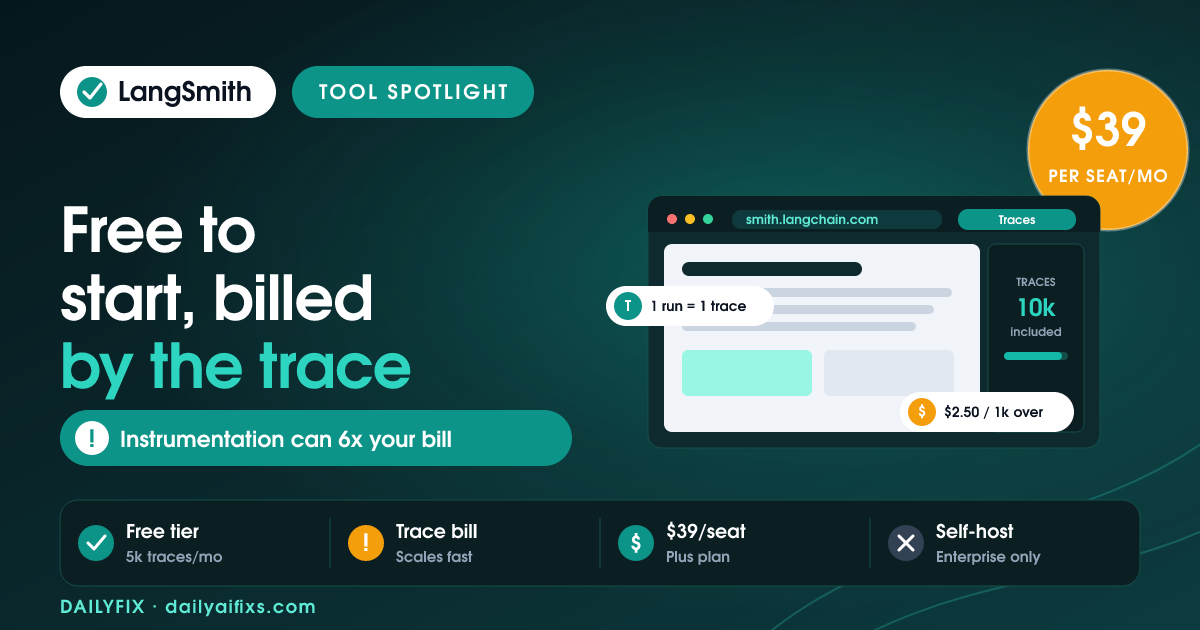
TL;DR: LangSmith pricing 2026 has three tiers: Developer (free, 1 seat, 5,000 base traces/month), Plus ($39 per seat/month, 10,000 base traces included, unlimited seats), and custom Enterprise. The catch is not the seat price. It is trace-based billing. Overages cost $2.50 per 1,000 base traces (14-day retention) or $5.00 per 1,000 extended (400-day), and how you instrument your agent can multiply the total several times over.
Last updated: August 2026 · By Sandeep Singh, DailyFix
LangSmith is the observability and evaluation layer for teams building AI agents, and as of August 2026 it has quietly become the default tool for anyone running LangChain or LangGraph in production. The pricing page looks friendly: a free plan, a flat $39 seat, and a custom enterprise tier. The real cost lives one layer down, in how LangSmith counts traces. This spotlight walks the exact numbers, the mechanic that surprises teams, and when a cheaper tool makes more sense.
What does LangSmith pricing look like in 2026?
LangSmith pricing in 2026 runs across three plans: Developer at $0 for one seat with 5,000 base traces a month, Plus at $39 per seat per month with 10,000 base traces and unlimited seats, and Enterprise at custom pricing. According to LangChain's official pricing page (checked August 2026), overage traces are billed pay-as-you-go on both self-serve plans.
The seat price is the part everyone quotes, but it is rarely the part that hurts. On Plus, five seats is $195 a month before you send a single trace over the included allowance. The included traces (5,000 on Developer, 10,000 on Plus) are the free runway; everything past that meters by volume and retention.
| Plan | Price | Seats | Base traces included |
|---|---|---|---|
| Developer | $0 | 1 | 5,000 / month |
| Plus | $39 / seat / month | Unlimited | 10,000 / month |
| Enterprise | Custom | Custom | Custom |
Overages on both self-serve plans: $2.50 per 1,000 base traces (14-day retention) and $5.00 per 1,000 extended traces (400-day retention); upgrading a base trace to extended costs an extra $2.50 per 1,000. Prices and limits change often — verify on the official pricing page before deciding.
How does LangSmith trace billing work?
LangSmith trace billing charges you per trace, where a trace is one full execution of your app, plus how long you keep it. Base traces live 14 days at $2.50 per 1,000; extended traces live 400 days at $5.00 per 1,000. The included monthly allowances are base traces. That single mechanic explains almost every "why is my bill this high" surprise.
A trace is not an LLM call. One agent run that fires 15 model calls and 10 tool calls is a single trace holding 25-plus steps. That is good news for allowances: your 10,000 included traces stretch much further than "10,000 model calls" would. It is bad news the moment your instrumentation gets granular.
Here is the trap the calculator widget never shows you. Trace count is a function of where your code starts a new top-level execution, not of your traffic. Take a support agent handling 50,000 sessions a month. Instrument each session as one execution and you emit 50,000 traces. Instrument each conversation turn as its own execution — a common default when every turn is a separate request handler — and a six-turn average session emits 300,000 traces. Same users, same model spend, six times the billable volume.
Two more things bill as traces that teams forget: evaluation runs and playground sessions. According to Inference.net's June 2026 pricing analysis, a nightly eval over a 2,000-example dataset adds roughly 60,000 traces a month, about $150 at the base rate. Run evals often over big datasets and that becomes a standing line item.
Worked math on Plus, so you can swap your own numbers in. A five-seat team running 50,000 traces a month pays $195 in seats plus 40,000 overage traces at $2.50 per 1,000, about $295 total at base retention, or about $395 if those traces need 400-day retention. Re-instrument the same traffic per turn to 300,000 traces and the overage alone jumps to roughly $725, pushing the bill near $920 for identical work.
What does the LangSmith free plan actually include?
The LangSmith free plan (Developer) gives you one seat, 5,000 base traces a month, and 14-day retention. Per LangChain's billing documentation, personal organizations are hard-capped at 5,000 traces a month until you add a credit card — traces do not queue, the cap is the cap. It is genuinely useful for prototyping and not meant to be a production budget.
Do the arithmetic on what 5,000 traces buys. A modest production agent can burn through 5,000 traces in a day or two. And because base retention is 14 days, nothing you capture today survives to become next quarter's eval dataset. The free tier is a sandbox for building and debugging, not a place to run a live agent for a real business.
One scoping note worth budgeting for: the LangSmith platform now bills more than observability. The same invoice can carry deployment runs, deployment uptime, Fleet runs, Engine compute, and sandboxes, metered in LangChain Compute Units (1 LCU = $1.50) and Storage Units (1 LSU = $1.00). If you adopt the wider platform, those meters stack on top of seats and traces.
What are the best LangSmith alternatives in 2026?
The best LangSmith alternatives in 2026 are Langfuse and Arize Phoenix if you want open source and self-hosting, and Braintrust or Helicone if you want a managed tool with a different billing unit. The catch across the whole market: every vendor meters a different thing, so comparing sticker prices without normalizing the unit is how teams get surprised twice.
| Tool | Billing unit | Free tier | Paid from | Self-host |
|---|---|---|---|---|
| LangSmith | Traces | 5k traces/mo | $39/seat/mo | Enterprise only |
| Langfuse | Units | 50k units/mo | $29/mo | Free (open source) |
| Arize Phoenix | Spans | 25k spans/mo | $50/mo | Free (open source) |
| Braintrust | GB + scores | 1 GB, 10k scores | $249/mo | Enterprise |
| Helicone | Requests | 10k requests/mo | $79/mo | Enterprise |
A Langfuse unit is any tracing data point (a trace, observation, or score), so one 25-span trace consumes 25 units. Helicone's cloud has been in maintenance mode since its March 2026 acquisition. Prices verified June 2026 — check each vendor before committing.
Pick by fit, not by headline price. If your stack is LangChain or LangGraph and your trace volume is modest against your headcount, LangSmith's native tracing and evals are worth the $39 seat. If you run high-volume agents where per-trace overage dominates, or you need long retention as the default, or you want to self-host without an enterprise contract, an open-source option like Langfuse or Arize Phoenix usually wins on cost.
Frequently asked questions
How much does LangSmith cost in 2026?
LangSmith has three tiers. Developer is free with one seat and 5,000 base traces a month. Plus is $39 per seat per month with 10,000 base traces included and unlimited seats. Enterprise is custom-priced. Overages run $2.50 per 1,000 base traces and $5.00 per 1,000 extended traces, verified on the official pricing page in June 2026.
Is LangSmith free to use?
Yes, for one developer with up to 5,000 base traces a month. Personal organizations are hard-capped at 5,000 traces per month until a credit card is added, and those traces are kept for only 14 days. That covers prototyping but not a production observability budget.
What is a trace in LangSmith?
A trace is a single execution of your application, such as one agent run, one evaluator run, or one playground session. A single trace can contain many steps, including multiple LLM calls and tool calls. One agent run that makes 15 model calls is still one trace, so included allowances go further than raw call counts suggest.
Do evaluation runs count toward the LangSmith bill?
Yes. Every evaluation run generates a billable trace. A nightly eval over a 2,000-example dataset adds roughly 60,000 traces a month, about $150 at the base rate. Frequent evals over large datasets are a real line item, not a rounding error.
Is LangSmith open source?
No. LangSmith is closed-source SaaS. Self-hosting exists only through the custom-priced Enterprise plan as a hybrid or fully self-hosted deployment. If you need open source or self-hosting without an enterprise contract, Langfuse and Arize Phoenix are both open source and free to self-host.
Why is my LangSmith bill higher than expected?
Trace count follows where your instrumentation starts a new execution, not your traffic. The same 50,000 sessions billed per conversation turn instead of per session can emit six times the traces and six times the overage. Extended 400-day retention also doubles the per-trace price versus 14-day base retention.
Bottom line
LangSmith is the right pick if you build on LangChain or LangGraph, your team is small, and your trace volume stays modest, because at low volume $39 per seat buys native tracing, evals, and a prompt hub that save real hours. It is the wrong pick if you run high-volume agents where per-trace overage dominates, need long retention by default, or want to self-host without an enterprise deal. Before you commit, multiply three numbers: traces your instrumentation emits, the fraction needing over 14 days, and seats. That product is your bill.
Sources
- LangChain / LangSmith official pricing page (checked August 2026)
- Inference.net — LangSmith Pricing Explained (2026): Traces, Seats & Alternatives (June 2026)
Related reads
- CrewAI Pricing 2026: Free or Enterprise
- Lindy AI Pricing 2026: The Usage-Meter Catch
- Relevance AI Pricing 2026: The Dual-Meter Catch
- Vellum AI Pricing 2026: What the Monthly Fee Includes