Octoparse Pricing 2026: The Add-On Catch
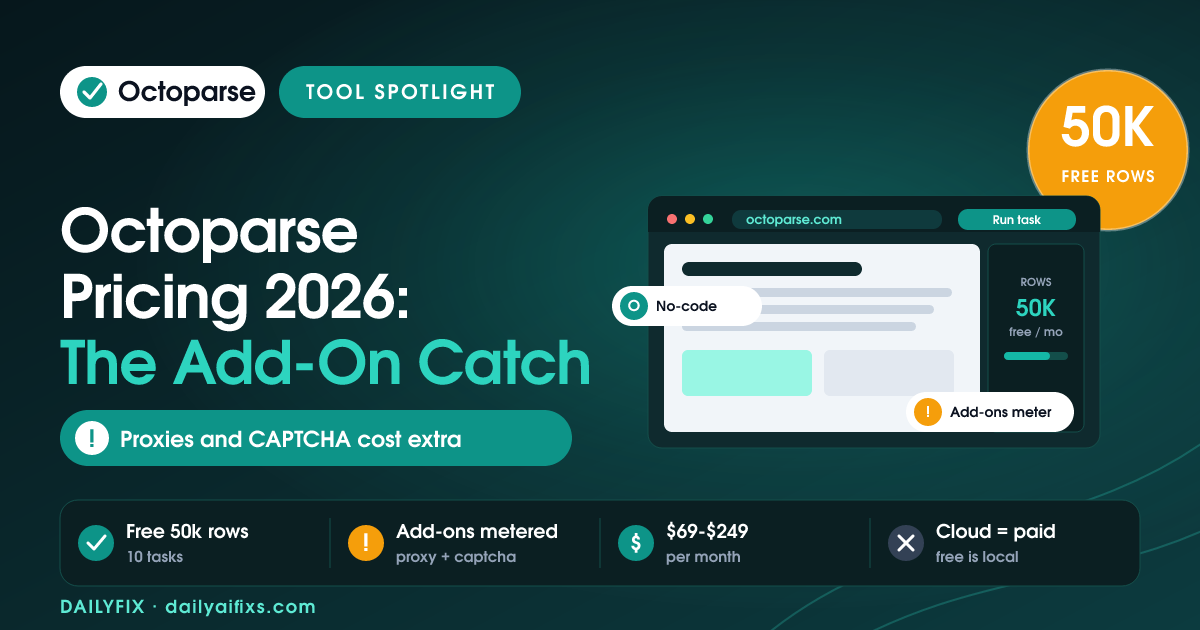
TL;DR: Octoparse pricing is free for 10 tasks and 50,000 rows a month (local only), then $69/mo (Standard) and $249/mo (Professional) on annual billing. The catch is that cloud extraction, residential proxies ($3/GB), and CAPTCHA solving ($1 per 1,000) are metered add-ons that the tiny included credit allowance barely covers.
Last updated: August 2026 · By Sandeep Singh, DailyFix
Octoparse is a no-code web scraper that turns websites into spreadsheets using a point-and-click recorder and 500+ templates. As of August 2026 its headline free plan looks generous at 50,000 rows a month, but the features that make scraping reliable at scale, cloud runs, proxies, and CAPTCHA solving, sit outside the base price. This breakdown shows what each tier includes and where the add-on meter kicks in. The pattern is familiar for scraping tools: the base plan looks affordable, but the anti-blocking features you need on any defended site are billed on top, so the sticker price and the real price diverge the moment a target fights back.
How does Octoparse pricing work in 2026?
Octoparse pricing has a free plan plus two main paid tiers. According to Octoparse's pricing page (checked August 2026), Standard is $69/month and Professional is $249/month, both billed annually with about 16% savings versus monthly billing, so monthly rates run higher.
The base fee buys tasks and cloud concurrency, but the running costs of real scraping, proxies and CAPTCHA solving, are billed separately as add-ons. Each paid tier includes only a small monthly add-on credit, so anti-blocking usage becomes an extra line on your bill.
What does the Octoparse free plan include?
The Octoparse free plan is free forever and includes 10 tasks, up to 50,000 rows of data export per month, local extraction, and 1 device, per Octoparse's pricing page (checked August 2026). No credit card is required, and the row allowance is generous for a free tier.
The key limit is that extraction is local only: scrapes run on your own computer, which must stay on, and you do not get cloud runs, scheduling, proxies, or CAPTCHA solving. The free plan is fine for occasional manual scrapes but cannot run unattended in the cloud.
What are Octoparse add-on credits?
Octoparse add-on credits are a small monthly allowance for anti-blocking features. Per Octoparse pricing breakdowns (checked August 2026), Standard includes about $2 a month in add-on credits and Professional about $9, which covers less than 1 GB of proxy bandwidth or roughly 2,000 CAPTCHA solves.
That tiny allowance is the catch. The moment a scrape needs residential proxies or CAPTCHA solving to avoid blocks, the included credit runs out and you pay usage on top of the plan. For any site with real anti-bot defenses, the sticker price understates the true monthly cost.
How much do proxies and CAPTCHA solving cost?
On Octoparse, residential proxies cost about $3 per GB of bandwidth, and CAPTCHA solving costs about $1 per 1,000 solves for most types and $1.50 per 1,000 for Cloudflare challenges, per Octoparse pricing breakdowns (checked August 2026). These are billed as usage beyond your plan's small add-on credit.
For lightly protected sites, this rarely matters. For protected targets, proxies and CAPTCHA can quietly become the largest part of your bill, since heavy scraping burns gigabytes of proxy bandwidth and thousands of CAPTCHA solves. Budget these separately rather than assuming the plan fee is the total.
Is Octoparse worth it versus other scrapers?
Octoparse is worth it for no-code users who need cloud scraping, scheduling, and templates without writing code, and whose target sites are only lightly protected. The 50,000-row free plan is also a strong way to test whether it can read the pages you care about.
It looks pricier once anti-blocking is factored in, because proxies and CAPTCHA are metered add-ons rather than included. Here is how the tiers compare on the numbers that decide your bill.
| Plan | Annual price/mo | Tasks | Rows export | Cloud extraction | Add-on credit |
|---|---|---|---|---|---|
| Free | $0 | 10 | 50,000 / mo | Local only | - |
| Standard | $69 | 100 | Unlimited | 3 concurrent | ~$2 / mo |
| Professional | $249 | Higher | Unlimited | More concurrent | ~$9 / mo |
Prices and limits change often — verify on the official pricing page before deciding.
FAQ
Is Octoparse free?
Yes, Octoparse has a free-forever plan that includes 10 tasks, up to 50,000 rows of data export per month, and 1 device. No credit card is required. The catch is that extraction is local only: scrapes run on your own computer and there is no cloud runs, scheduling, proxies, or CAPTCHA solving on the free tier.
How much does Octoparse cost?
Octoparse costs $69 per month for Standard and $249 per month for Professional, both billed annually with about 16% savings over monthly billing, so monthly rates are higher. Each paid plan includes only a small add-on credit for proxies and CAPTCHA, so anti-blocking usage is billed on top of the base fee.
What are Octoparse add-on credits?
Add-on credits are a small monthly allowance for anti-blocking features. Standard includes about $2 a month and Professional about $9, enough for under 1 GB of proxy bandwidth or roughly 2,000 CAPTCHA solves. Once that runs out, residential proxies and CAPTCHA solving are billed as usage on top of your plan.
How much are Octoparse proxies and CAPTCHA?
Residential proxies cost about $3 per GB of bandwidth, and CAPTCHA solving costs about $1 per 1,000 solves, rising to $1.50 per 1,000 for Cloudflare challenges. These charges apply after your small monthly add-on credit is used up, so scraping well-protected sites can cost far more than the plan's sticker price.
Can Octoparse run in the cloud?
Cloud extraction is a paid feature. On the free plan, scrapes run locally on your own computer, which must stay on. The $69 Standard plan adds cloud extraction with 3 concurrent processes plus scheduling, and Professional adds more concurrency. If you need unattended, scheduled scraping, you need at least the Standard tier.
Is Octoparse better than Browse AI or Apify?
Octoparse is a no-code desktop scraper with templates and cloud runs, best for lightly protected sites. Browse AI focuses on monitoring and turning pages into spreadsheets, and Apify is a developer platform with proxies and 55,000+ Actors. Octoparse suits non-coders; Apify scales better for heavy, protected, or custom scraping.
Bottom Line
Octoparse is a solid no-code scraper for non-developers who need cloud runs, scheduling, and templates on lightly protected sites, and the 50,000-row free plan is a genuine way to test it. Just price the add-ons: proxies at about $3 per GB and CAPTCHA at about $1 per 1,000 sit outside the plan, and the small included credit barely covers them. For heavily protected targets, budget proxies and CAPTCHA separately, or consider a developer platform built for scale. As a rule of thumb, treat the plan fee as a floor and add a realistic proxy-and-CAPTCHA line before you compare Octoparse against rivals.
Sources
Related reads
- Browse AI Pricing 2026: The Credit Reset Catch
- Apify Pricing 2026: The Compute Unit Catch
- Bardeen AI Pricing 2026: The Credit Per Row Catch
- Zapier Pricing 2026: The Shared Task Pool Catch