VectorShift Pricing 2026: The Two-Meter Catch
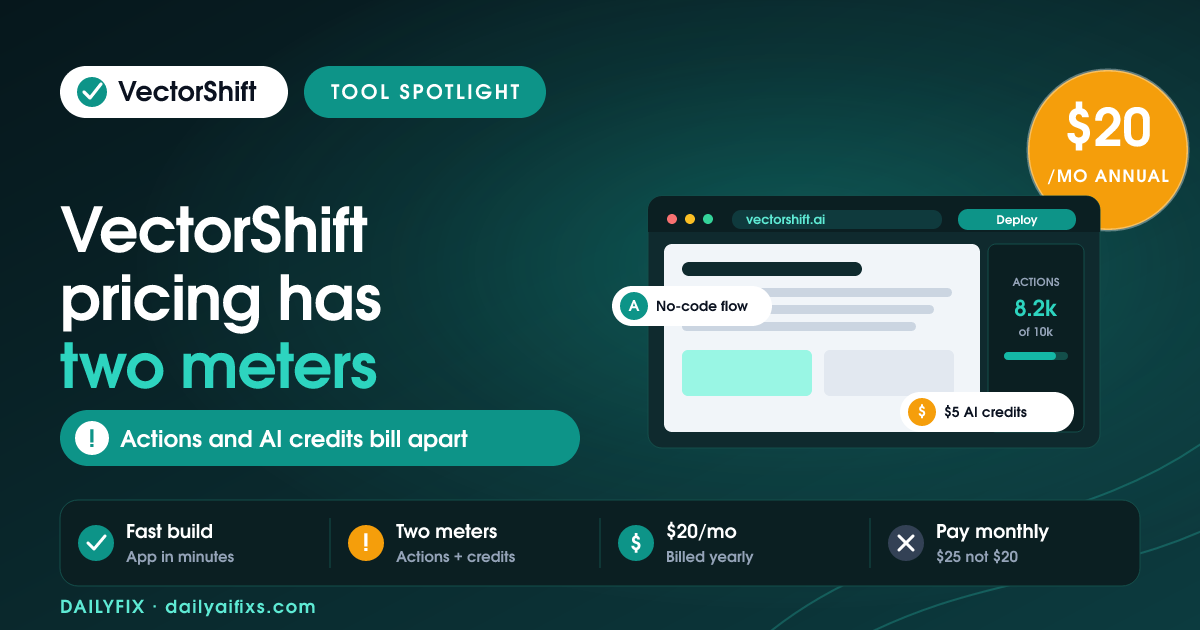
TL;DR: VectorShift pricing starts free, then $20/month for Standard and $100/month for Pro — but only billed annually. Pay monthly and those become $25 and $125. The real catch is two separate meters: pipeline actions and AI credits. LLM calls are not pipeline actions; they spend your $5 monthly credit, then bill usage-based on top of the plan.
Last updated: August 2026 · By Sandeep Singh, DailyFix
VectorShift is a no-code platform for building AI chatbots, assistants, and workflow automations by dragging nodes on a canvas — with a code SDK underneath for anyone who wants it. It has climbed the 2026 "best no-code AI agent builder" lists next to Relevance AI and n8n, and the free tier makes it easy to try. But the price you see on the pricing page is not the price you pay once your workflows actually run. Below is how VectorShift pricing works as of August 2026, meter by meter, so you can budget before you build.
What are the VectorShift pricing plans in 2026?
VectorShift pricing has three self-serve tiers: a free Starter plan, Standard at $20/month, and Pro at $100/month, both billed annually. According to VectorShift's pricing page (checked August 2026), Standard adds 5 pipelines and 10,000 pipeline actions a month, while Pro unlocks unlimited pipelines and 100,000 actions. Every paid tier also includes just $5 of AI credits per month, then charges usage-based after that.
The tiers scale on more than price. Storage climbs from 1 GB to 10 GB, knowledge-base capacity from 200 vectors (roughly 200 pages) to 25,000, and integrations from one to unlimited. Support moves from Discord and email on the lower tiers to Slack and dedicated help on Pro. For a solopreneur, the jump that matters is Starter to Standard, because that is where you go from one locked pipeline to a real, five-workflow setup.
VectorShift pricing at a glance
| Plan | Annual price | Monthly price | Pipelines | Pipeline actions/mo | AI credits |
|---|---|---|---|---|---|
| Starter | Free | Free | 1 | 1,000 | $1 once at signup |
| Standard | $20/mo | $25/mo | 5 | 10,000 | $5/mo, then usage-based |
| Pro | $100/mo | $125/mo | Unlimited | 100,000 | $5/mo, then usage-based |
Prices and limits change often — verify on the official pricing page before deciding.
What does the VectorShift free plan actually include?
The VectorShift free plan (Starter) gives you one pipeline, 1,000 pipeline actions per month, one chatbot interface, 1 GB of file storage, one knowledge base holding 200 vectors, one integration, and a single $1 of AI credits at signup — no card required. It is a genuine build-and-test sandbox, but the one-pipeline and one-integration caps mean you cannot run more than a single small automation live.
The $1 signup credit is the quiet limit. Because AI model calls draw from credits rather than the action allowance, a free-plan chatbot answering with GPT-class or Claude-class models can exhaust that dollar in a modest test session. After it is gone, LLM steps stop until you upgrade. Treat the free plan as a way to prove your idea works, not as a place to host anything a customer touches.
What is the difference between pipeline actions and AI credits?
Pipeline actions and AI credits are two independent meters in VectorShift, and mixing them up is where budgets break. A pipeline action is when a pipeline "does something" — querying a knowledge base, sending data through an integration, or outputting a result. Per VectorShift's pricing footnote (checked August 2026), calling an LLM is explicitly not a pipeline action; model calls spend AI credits instead.
That split matters because the marketing headline is the action count — 10,000 on Standard, 100,000 on Pro. Those numbers look generous. But an AI workflow's expensive part is usually the model call, and that runs on the $5 monthly credit, then usage-based pricing. So you can be nowhere near your action cap and still get a surprise credit bill. When you estimate cost, price the LLM calls first and treat pipeline actions as the cheaper, secondary meter.
Is VectorShift cheaper billed annually or monthly?
VectorShift is cheaper billed annually — the advertised prices assume it. Standard is $20/month annually but $25/month if you pay month to month, and Pro is $100 versus $125. That is a 20 percent saving for committing to a year, or about $60 on Standard and $300 on Pro across twelve months, based on VectorShift's pricing page in August 2026.
For a solopreneur testing a new build, monthly billing is the safer start even at the higher rate, because you are not locked in while you find out whether the AI-credit burn fits your budget. Once a workflow is earning or clearly saving you time, switch to annual to bank the discount. Do not sign an annual plan on day one just to see the lower sticker price — the two-meter usage cost is the number you actually need to validate first.
Is VectorShift worth it for a solopreneur?
VectorShift is worth it for a solopreneur who wants to ship an AI chatbot, internal assistant, or data workflow in an afternoon without wiring up code — the drag-and-drop canvas plus SDK genuinely gets you from idea to deployed app fast, and reviewers consistently praise the ease of use and integrations. At $20/month for five pipelines, it undercuts a lot of agent platforms.
The reason to hesitate is cost predictability, not capability. The pipeline-action and AI-credit meters mean your real monthly bill depends on usage you cannot fully see until traffic arrives. For a low-volume internal tool, that is a non-issue. For a public chatbot with unknown traffic, model the credit burn before you promise anyone a price. If you need custom model training or one flat bill, look elsewhere.
Frequently asked questions
Is VectorShift really free?
Yes, the Starter plan is free with no credit card. You get 1 pipeline, 1,000 pipeline actions per month, 1 chatbot interface, 1 GB storage, 1 knowledge base with 200 vectors, 1 integration, and a one-time $1 of AI credits. It is enough to test one small workflow, not to run a live product.
What is a pipeline action in VectorShift?
A pipeline action is when a VectorShift pipeline does something — querying a knowledge base, sending data through an integration, or outputting a result. Per VectorShift's pricing page, calling an LLM is not a pipeline action. Model calls draw down your separate AI credit balance instead, so the two meters run in parallel.
Does VectorShift charge extra for AI model usage?
Yes. Paid plans include $5 of AI credits per month, then bill usage-based afterwards. Every LLM call in your workflow spends those credits on top of the monthly subscription. Heavy chatbots or long-context agents can burn through $5 quickly, so budget for credit overage separately from the plan price.
Is VectorShift cheaper billed annually or monthly?
Annually. The advertised $20 Standard and $100 Pro prices assume annual billing. Paying monthly costs $25 for Standard and $125 for Pro — about 25 percent more. Annual billing locks you in for a year but saves roughly $60 on Standard and $300 on Pro across twelve months.
What happens when I hit the pipeline action limit?
Standard caps at 10,000 pipeline actions per month and Pro at 100,000. The Pro plan continues on usage-based pricing if you exceed the plan, per VectorShift's monthly pricing view. On lower tiers you are expected to upgrade. Track your action count early, because a busy chatbot can reach 10,000 actions faster than expected.
Who should not use VectorShift?
Skip VectorShift if you need deep custom model training or large-scale data science — it is built for assembling AI apps from existing models, not training your own. It is also weak for anyone who wants a single flat bill, because the pipeline-action and AI-credit meters make total monthly cost hard to predict upfront.
Bottom line
VectorShift is one of the fastest ways to build and deploy a no-code AI app in 2026, and $20/month for five pipelines is fair for what you get. Buy it if you want a chatbot or workflow live this week and your usage is low or internal. Hold off if your traffic is unknown or your budget is tight, because the separate AI-credit meter can turn a $20 plan into a bigger bill without warning. Start on the free plan, model your model-call cost, then commit annually only once the numbers hold up.
Sources
- VectorShift official pricing page (checked August 2026)
- ColdIQ — VectorShift Review: Features, Pricing & Alternatives (2026)
Related reads
- Relevance AI pricing 2026: the dual-meter catch
- Lindy AI pricing 2026: the usage-meter catch
- Dust pricing 2026: the per-seat credit meter
- Stack AI pricing 2026: free, then call sales