Dify Pricing 2026: The 200-Credit Free Wall
TL;DR: Dify pricing 2026 runs on four tiers — a free Sandbox capped at 200 message credits for the lifetime of the account, Professional at $59/month for 5,000 credits, Team at $159/month for 10,000 credits, and custom Enterprise. The open-source Community Edition is free to self-host, but that shifts the cost to your own servers, updates, and maintenance instead of a monthly bill.
Last updated: August 2026 · By Sandeep Singh, DailyFix
Dify is one of the most popular open-source platforms for building AI agents, RAG chatbots, and LLM workflows without writing much code. As of August 2026 it is showing up on nearly every "best AI agent tools" list, which means a lot of solo builders are about to hit its pricing page for the first time. The plans look simple. The catch is buried in one word on the free tier: "lifetime."
How much does Dify cost per month?
Dify costs $0 on the free Sandbox, $59/month on Professional, and $159/month on Team, with Enterprise quoted custom. According to Dify's official pricing page (checked August 2026), paying annually drops Professional to $590/year and Team to $1,590/year — roughly 17% off. Every paid tier is billed per workspace, before any tax.
Here is the full picture in one place so you can size a plan against your actual usage rather than the headline number:
| Plan | Price | Message credits | Members | Apps | Knowledge storage |
|---|---|---|---|---|---|
| Sandbox | Free | 200 total (lifetime) | 1 | 5 | 50MB |
| Professional | $59/mo ($590/yr) | 5,000 / month | 3 | 50 | 5GB |
| Team | $159/mo ($1,590/yr) | 10,000 / month | 50 | 200 | 20GB |
| Enterprise | Custom quote | Custom | Custom | Custom | Custom |
Prices and limits change often — verify on the official pricing page before deciding.
What are the Dify free plan limits?
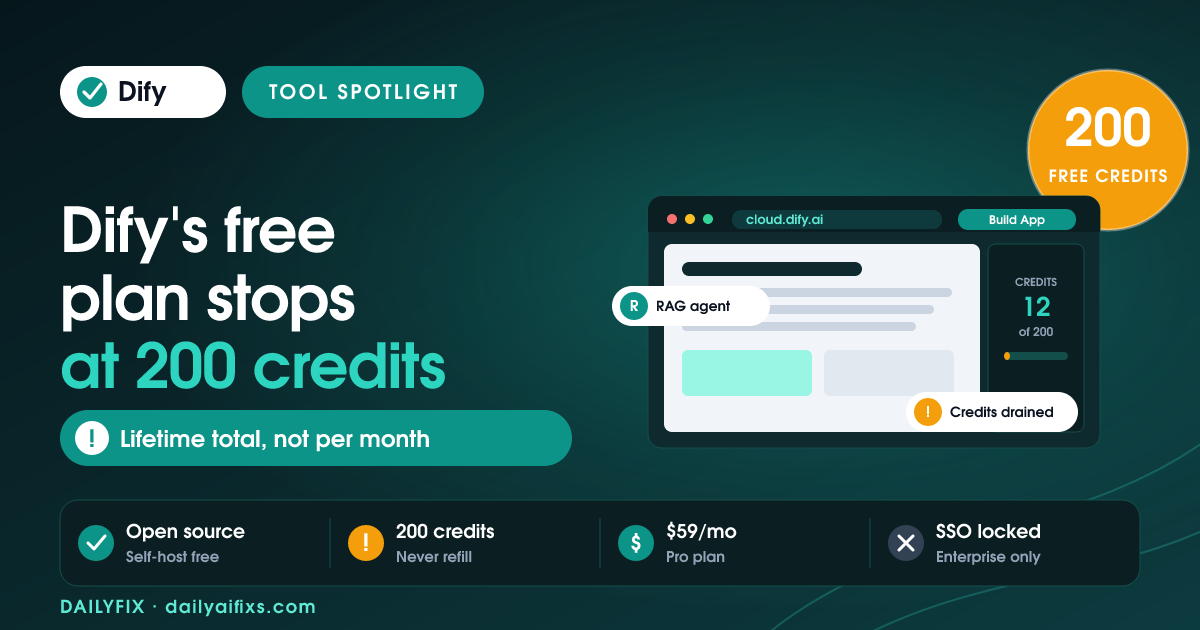
The Dify free plan limits are strict: the Sandbox gives you 200 message credits for the entire life of the account, one team member, five apps, 50 knowledge documents, 50MB of storage, and 30 days of log history. Dify's pricing page (checked August 2026) lists those 200 credits as a total, not a monthly refill — that is the single most misread line on the page.
Two hundred credits sounds like a soft trial limit until you realize it never resets. A chatbot that answers a handful of test questions a day can burn through it inside a week of real prototyping. Once the credits are gone, the Sandbox stops serving credit-based model calls, and you either upgrade or switch to your own API key. Treat the Sandbox as a demo, not a place to run anything a real user touches.
How do Dify message credits work?
Dify message credits are a metered unit that roughly maps to one round-trip call to a hosted model, and they are consumed based on which model you pick — a heavy frontier model eats more than a small one. According to Dify's pricing notes (checked August 2026), credits exist so you can try models from OpenAI, Anthropic, Gemini, xAI, and DeepSeek without wiring up your own keys first.
The important nuance: credits are optional infrastructure, not a hard paywall. When your monthly allowance runs dry on a paid plan — or the 200 lifetime credits vanish on Sandbox — you connect your own model API key and keep going, paying that provider directly. So your true bill is two layers: the Dify subscription plus whatever the underlying models charge for your traffic. Budget both, because a busy agent's model spend can quietly dwarf the $59 plan fee.
Is Dify self-hosted really free versus cloud?
The Community Edition of Dify is genuinely free to self-host with Docker, with no license fee and no message-credit cap. But "free" software is not the same as free operation: you own the server, the vector database, updates, backups, monitoring, and security. Independent guides note the total cost of a self-hosted setup often lands higher than a cloud subscription once you price in your own time.
For a solo builder shipping one or two apps, the math usually favors Dify Cloud. Paying $59/month buys managed hosting, priority processing, and no ops burden — cheaper than the hours you would spend babysitting a self-hosted stack. Self-hosting earns its keep in two cases: high call volume where cloud credits get expensive, or strict requirements to keep data on your own infrastructure. A word of caution reported by teams: the commercial license and enterprise features (SSO, multiple workspaces) are not in the free build — those live only in Enterprise.
How does Dify pricing 2026 compare to alternatives?
Against other open-source LLM app builders, Dify pricing 2026 sits mid-pack: pricier entry than a pure self-host, but cheaper and faster to launch than stitching a stack together yourself. The closest comparisons for a solopreneur are Flowise, Langflow, and n8n, each with a different free-vs-paid trap.
| Tool | Free option | Paid entry | The catch |
|---|---|---|---|
| Dify | Sandbox (200 lifetime credits) or self-host | $59/mo | Free credits never refill |
| Flowise | Open-source self-host | Cloud from ~$35/mo | Hidden stack + hosting cost |
| Langflow | Open-source self-host | Managed tiers | "Free" still needs infra |
| n8n | Self-host free | Cloud from ~$24/mo | Cloud vs self-host tradeoff |
Figures are indicative and change often — confirm on each tool's official pricing page before deciding.
If you want the fastest path from prompt to a working agent with a clean UI and built-in RAG, Dify is the strongest of this group. If you are comfortable running Docker and want zero subscription, Flowise or Langflow self-hosted undercut it — as long as your time is worth less than the ops hours.
Frequently asked questions
Is Dify actually free to use?
Yes, two ways. The Dify Cloud Sandbox is free but capped at 200 message credits for the whole lifetime of the account, one member, and five apps. The open-source Community Edition is free forever if you self-host it with Docker, though you pay in server and maintenance time instead of a subscription.
What happens when I run out of Dify message credits?
When your Dify message credits are used up, you can plug in your own model API key (OpenAI, Anthropic, Gemini, DeepSeek, and others) and keep running, paying that provider directly. Credits are a convenience for trying models inside Dify, not the only way to run your apps.
How much does the Dify Professional plan cost?
The Dify Professional plan is $59 per month, or $590 per year (about 17% off). It includes 5,000 message credits per month, 3 team members, 50 apps, 500 knowledge documents, and 5GB of knowledge storage. It is aimed at solo builders and small teams shipping production apps.
Is self-hosting Dify cheaper than the cloud plans?
It can be, but not always. The Community Edition has no license fee, yet you cover hosting, a vector database, updates, backups, and security yourself. For a solo builder, the $59 Professional plan is often cheaper once you count your own time. Self-hosting wins at higher volume or when data must stay on your servers.
Does Dify charge for LLM usage on top of the plan?
Effectively yes. Message credits cover model calls only until they run out, then you connect your own API key and pay the model provider (OpenAI, Anthropic, and so on) directly. So your real monthly cost is the Dify subscription plus whatever the underlying models charge for your traffic.
Who should not pay for Dify Cloud?
If you only want to test one small app, the free Sandbox or self-hosted Community Edition is enough and paid tiers are overkill. Teams needing SSO, multiple workspaces, or a commercial license for the open-source build are pushed to Enterprise, which is quote-only and priced well above the $159 Team plan.
Bottom Line
Dify is worth it if you are a solo builder or small team who wants to ship AI agents and RAG apps fast without managing infrastructure — the $59 Professional plan is fair for what it removes from your plate. Do not treat the free Sandbox as a runway; its 200 credits are a one-time trial, not a monthly budget. Skip Dify Cloud if you are happy running Docker and want no subscription, or if you need SSO and a commercial license, which force you into a custom Enterprise quote.
Sources
- Dify official pricing page (checked August 2026)
- Hakky Handbook — Dify pricing guide and the 200-message free limit
Related reads
- Langflow Pricing 2026: The Free Open-Source Myth
- Flowise Pricing 2026: The Hidden Stack Cost
- n8n Pricing 2026: When Cloud Beats Self-Hosting
- CrewAI Pricing 2026: Free or Enterprise
- Stack AI Pricing 2026: Free, Then Call Sales