Langflow Pricing 2026: The Free Open-Source Myth
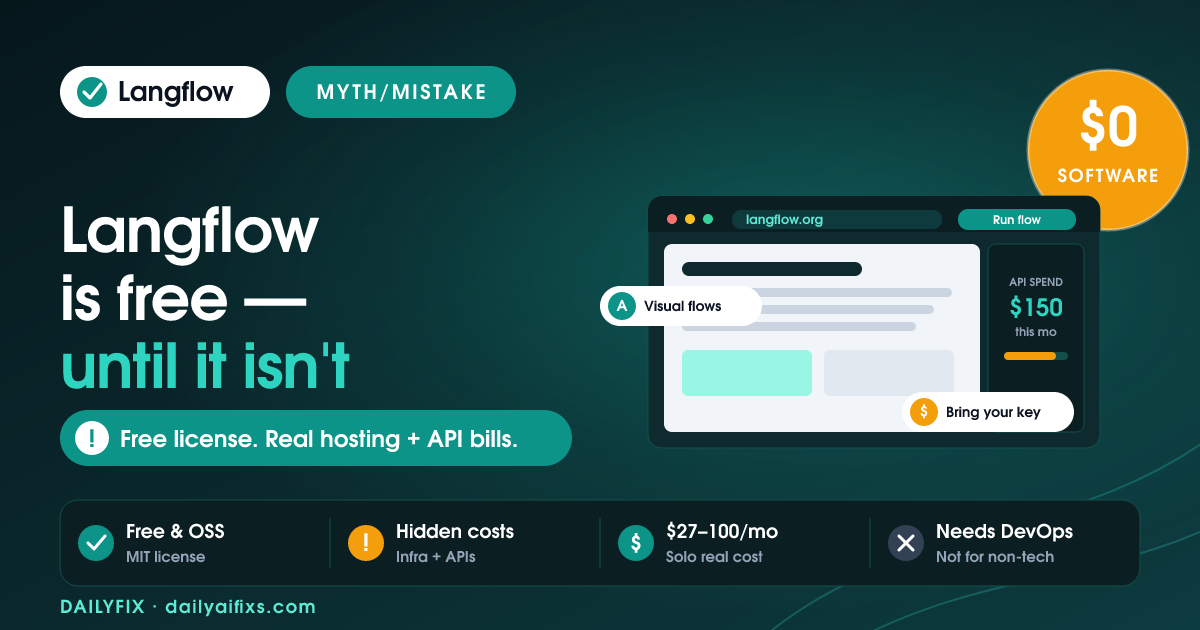
TL;DR: Langflow pricing is the internet's favorite half-truth. The software is free and open source, but running it is not. As of August 2026, a realistic bill lands near $27–$100 a month for a solo builder and $389–$500 for a small team, driven by cloud hosting, LLM API usage, and vector databases. The word "free" covers the license, not the monthly total.
Last updated: August 2026 · By Sandeep Singh, DailyFix
Langflow is one of the most popular ways to build AI agents and retrieval apps with a drag-and-drop canvas instead of raw code. It was acquired by DataStax in 2024 and, per Miniloop's 2026 write-up, is now moving under IBM — while staying open source. That "open source and free" headline is true, and it is exactly why so many people budget $0 and then get surprised. Below is what you actually pay, checked against Langflow's own model and independent cost breakdowns as of August 2026.
Is Langflow actually free?
Yes, the Langflow software is genuinely free and open source under a permissive license, with no seat fees and no usage caps on the code itself. You can self-host it, modify it, and ship commercial products on it without paying Langflow a cent. The catch is that free software still needs paid infrastructure to run, so "free" describes the license, not your monthly outflow.
DataStax has publicly committed to keeping Langflow "forever open, free, and agnostic," per Miniloop's breakdown. That commitment is real and worth taking at face value. But it applies to the framework — the part you download — not to the servers, model APIs, and databases that a working flow depends on. Treat the license as free and everything downstream as billable.
How much does Langflow Cloud cost?
Langflow Cloud has a free tier for trials and small pilots and, as of August 2026, no publicly listed paid subscription — production pricing is quoted through "contact sales," per Lindy's pricing analysis. So the hosted option starts at $0, but that number is misleading because you still bring your own LLM API keys and any external vector database.
In practice, Langflow Cloud is best treated as a fast on-ramp: spin up a flow in minutes without managing a server, validate an idea, then decide whether to self-host or talk to sales for a production tier. The reason users struggle to predict Langflow Cloud cost is that the meter that matters — token usage on OpenAI, Anthropic, or Google — sits outside Langflow entirely.
What does self-hosting Langflow really cost?
Self-hosting Langflow costs roughly $5–$20 a month for a development box and $24–$60 a month for a small production server, per Miniloop's 2026 infrastructure tables. A 2–4 GB test instance on DigitalOcean or Hetzner sits at the low end; an always-on 8 GB production node lands in the middle. Add managed Kubernetes and the hosting subtotal jumps by roughly $85–$195 a month.
Those are just the machines. Production deployments usually add monitoring — Grafana Cloud from about $19 a month or Datadog around $15 per host per month, according to Miniloop — plus storage and backups. None of these are Langflow charges; they are the standard cost of hosting any real service, which is precisely the part the "it's free" framing skips.
Why LLM API bills are the real Langflow pricing shock
LLM API usage is the largest and least predictable part of Langflow pricing, making up about 40–60 percent of a typical bill per Miniloop's 2026 estimate. Langflow ships no bundled model, so every run calls a paid API. According to Miniloop's January 2026 rate table, GPT-4o costs about $2.50 per million input tokens and $10 per million output tokens, while Claude 3.5 Sonnet runs $3 and $15.
Turned into monthly reality, light use of 50–100 queries a day costs roughly $10–$30, moderate use of 500–1,000 queries lands at $50–$150, and heavy production traffic of 5,000–10,000 queries a day can reach $300–$800. Retrieval flows add embedding calls on top. The fix is boring but effective: route simple steps to cheaper models like GPT-4o-mini or Claude Haiku, and cache repeated queries.
Langflow vs Flowise, n8n and flat-rate alternatives
Against flat-rate tools, Langflow trades predictable billing for control. Flowise is the closest match — also free, open source, and infrastructure-billed — while n8n (free, paid from about $20 a month), Make (from $10.59 a month), and Lindy (free for 40 tasks, then $49.99 a month) give you a fixed number you can forecast. Figures below are from Miniloop's and Lindy's August 2026 comparisons.
Langflow vs flat-rate alternatives (August 2026)
| Tool | Headline price | Cost model | Best for |
|---|---|---|---|
| Langflow | Free software + infra | You pay hosting, APIs, vector DB | Developers building custom RAG/agents |
| Flowise | Free software + infra | Same pay-your-own model as Langflow | Fast chatbot deployment |
| n8n | Free / from ~$20/mo | Flat plan, 400+ integrations | Automation with AI steps |
| Make | From ~$10.59/mo | Flat, operation-based tiers | No-code SaaS connections |
| Lindy | Free 40 tasks / $49.99/mo | Flat, task-based | Non-technical teams |
Langflow real monthly cost by use case
| Use case | Hosting | LLM APIs | Vector DB + monitoring | Realistic total |
|---|---|---|---|---|
| Solo dev / prototype | ~$12 | ~$15 | Free tiers | $27–$50/mo |
| Startup team (5–10) | ~$150 | ~$150 | ~$70–$90 | $389–$500/mo |
| Enterprise | ~$800 | ~$1,500 | ~$500+ | $3,300+/mo |
Figures from Miniloop and Lindy, checked August 2026. Prices and limits change often — verify on the official pricing page before deciding.
Frequently asked questions
Is Langflow free to use?
Yes. Langflow is open source and free under a permissive license, so the software carries no license fee. You can download it, self-host it, and use it commercially at no charge. What you pay for is everything around it: the server that runs it, the LLM API keys it calls, and any vector database you connect.
How much does Langflow Cloud cost per month?
Langflow Cloud has a free tier for trials and small pilots, and no publicly listed paid subscription. Production pricing is quoted through sales. Even on the free tier you still pay separately for the LLM API calls and any external vector database your flows use, so a live Cloud project rarely costs literally nothing.
What is the biggest hidden cost of running Langflow?
LLM API usage. According to Miniloop's 2026 breakdown, API calls make up roughly 40 to 60 percent of a typical Langflow bill. Light use runs $10 to $30 a month, moderate use $50 to $150, and heavy production traffic can pass $800. Hosting and vector databases are smaller, more predictable line items.
Is Langflow cheaper than n8n or Zapier?
It depends on scale. Langflow has no subscription, so a tiny hobby flow can be cheaper than n8n's or Zapier's paid tiers. But because Langflow costs scale with hosting and token usage, a busy team can end up paying more than a flat n8n plan from about $20 a month or Zapier from about $29.99 a month.
Do I need a vector database to use Langflow?
Only if you build retrieval or RAG flows that search your own documents. Simple prompt-chaining or agent flows run without one. When you do need vectors, free tiers from Pinecone, Qdrant, or DataStax Astra cover testing, while production plans start around $25 to $70 a month depending on the provider and scale.
Is Langflow a good fit for a non-technical solo operator?
Not really. Langflow is a visual builder, but running it in production means managing servers, API keys, and monitoring. If you have no development background and want predictable pricing, a flat-rate tool such as Lindy, Make, or n8n will get you live faster. Langflow rewards people who want control and can handle light DevOps.
Bottom line
Langflow is free where it counts — the framework — and genuinely powerful for building custom AI agents and RAG apps. But budget for the real bill: about $27–$100 a month solo, $389–$500 for a small team, and thousands at enterprise scale, almost all of it hosting and LLM API usage rather than Langflow itself. Choose Langflow if you want control and can handle a little DevOps. If you are non-technical or need a predictable monthly number, a flat-rate tool like n8n, Make, or Lindy is the smarter buy.
Sources
Related reads
- Flowise Pricing 2026: The Hidden Stack Cost
- CrewAI Pricing 2026: Free or Enterprise
- LangSmith Pricing 2026: The Trace Billing Catch
- n8n Pricing 2026: When Cloud Beats Self-Hosting