Retool Pricing 2026: The Agent Hours Catch
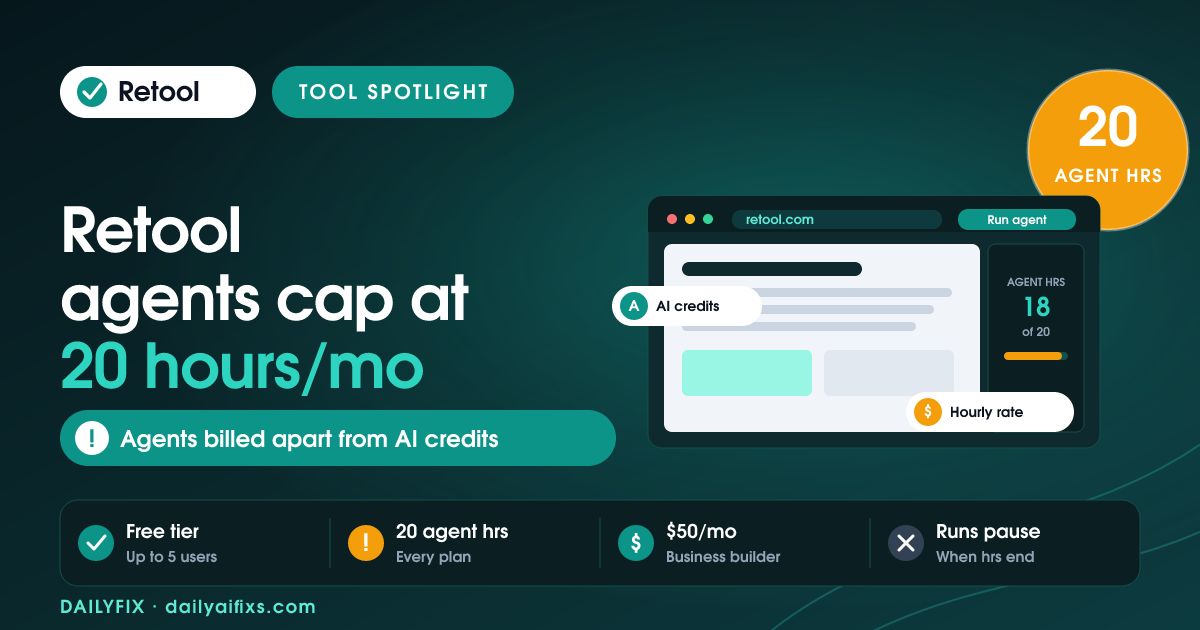
TL;DR: Retool pricing 2026 starts at $0 for up to 5 users, then $10 per builder (Team) and $50 per builder (Business, billed annually). The catch: every plan, free through Enterprise, caps AI agents at 20 hours a month, and agents are billed separately by the hour rather than from your AI credit pool. When the hours run out, agents pause.
Last updated: August 2026 · By Sandeep Singh, DailyFix
What is the full Retool pricing 2026 breakdown?
The full Retool pricing 2026 structure has four tiers: Free at $0 for up to 5 users, Team at $10 per builder per month, Business at $50 per builder per month billed annually ($65 month-to-month), and Enterprise at custom pricing. As of August 2026, Retool also splits users into three priced classes and bundles AI credits and agent hours into every tier.
According to Retool's pricing page (checked August 2026), builders are enabled users who built or edited an app or workflow during the billing cycle, while internal users are those who only viewed or used apps. Internal users cost $5 per month on Team and $15 per month on Business. Team includes 1,000 AI credits a month (750 base plus a 250 bonus) and 5,000 workflow runs; Business bumps that to 3,000 AI credits and adds SSO, audit logs, permission controls, and embedded apps. Extra workflow runs cost $75 per additional 5,000 runs per month on both paid tiers. Every figure here traces to the live pricing page, but prices and limits change often, so verify on the official page before you commit budget.
What is the Retool agent hours catch?
The Retool agent hours catch is that every plan, from Free to Enterprise, includes only up to 20 agent hours a month, and agents are billed separately by the hour instead of drawing from your AI credit pool. When the free hours run out, agent execution pauses until you buy more capacity or upgrade. Upgrading your plan does not raise the 20-hour floor; it changes credits and seats, not the agent allowance.
This trips people up because Retool markets a generous AI credit pool alongside its agents, so it is easy to assume credits pay for agent runs. They do not. According to Retool's pricing page (checked August 2026), agents are AI-powered workers billed hourly, and an agent hour is measured as wall-clock runtime, including step execution, API waits, and model processing, with idle time waiting for human input excluded. Hourly rates also vary by the model you assign, so a heavier reasoning model drains your 20 free hours faster than a lightweight one. For a solopreneur running a support-triage or research agent a few hours a day, 20 monthly hours can disappear inside a single week.
AI credits — pay for app building and AI Actions; 250/mo (Free) up to 3,000/mo (Business). Renew monthly, no rollover.
Agent hours — pay for autonomous agents by wall-clock time; capped at 20/mo on every plan, billed at model-specific hourly rates. These meters never share a balance.
How do Retool AI credits work?
Retool AI credits are a monthly, account-level pool that covers app building and AI Actions, not agents. Each plan includes a set amount: 250 credits a month on Free, 1,000 on Team, 3,000 on Business, and up to 10,000 on Enterprise. Credits renew each billing cycle and do not roll over, and paid plans can buy additional credit packs when the pool runs dry.
To make the number concrete, Retool's own pricing FAQ (checked August 2026) states that each AI prompt uses about 12 credits and a typical app takes three to six prompts to build, so a Business plan's 3,000 credits cover roughly 36 to 84 apps a month. That is plenty for most solo builders. The credits are pooled across your whole organization, so a busy team shares one balance. One useful escape hatch: Enterprise customers can connect their own model provider API key, which routes AI calls through that key and skips the credit pool entirely, though you then pay your model provider directly and the 20-hour agent cap still applies.
Is the Retool free plan enough for a solopreneur?
The Retool free plan is enough for most solopreneurs building internal tools, but not for client-facing automation at scale. It includes unlimited web and mobile apps, up to 5 users, 500 workflow runs a month, 5GB of database and 5GB of file storage, 250 AI credits, and up to 20 agent hours. That is a real working tier, not a trial, and you can ship internal dashboards and CRUD tools on it.
Where the free plan runs out is governance and volume. It has no SSO, no audit logs, no staging environment, and no rich permission controls, which land on Business. The 500 workflow runs a month is the other ceiling; a single automation firing every few minutes will blow past that quickly, and unlike Team and Business there is no paid overage on Free, so runs simply stop. For a government-employee side setup or a lean freelance operation testing whether Retool fits, start free, watch the usage dashboard for a few weeks, then decide whether the workflow runs or agent hours are what push you to pay.
What's the difference between Retool builders and internal users?
The difference between Retool builders and internal users is who edits versus who only uses. A builder is any enabled user who built or edited an app or workflow during the billing cycle; an internal user is an enabled user who did not. Builders cost more ($10 on Team, $50 on Business per month) because they create; internal users cost less ($5 on Team, $15 on Business).
This matters for budgeting because the same person's cost depends on their behavior in a given month, and on Business you can lock internal users out of editing with permission controls so they stay in the cheaper class. There is also a third class: external users, meaning people outside your organization such as clients or partners. On Business, external users are volume-tiered — free for the first 50, then $8 per month for 51 to 250, $6 for 251 to 500, and $4 above 500. A widely shared internal tool can quietly rack up external-user cost that dwarfs the builder seats, so count builders and end users as separate line items.
Retool pricing 2026 at a glance
| Plan | Price (per builder) | AI credits/mo | Agent hours/mo | Workflow runs/mo |
|---|---|---|---|---|
| Free | $0 (up to 5 users) | 250 | Up to 20 | 500 |
| Team | $10 ($5/internal user) | 1,000 | Up to 20 | 5,000 (+$75/5,000) |
| Business | $50 annual / $65 monthly | 3,000 | Up to 20 | 5,000 (+$75/5,000) |
| Enterprise | Custom | Up to 10,000 | Up to 20 | Custom |
Prices and limits change often — verify on the official pricing page before deciding. Figures checked August 2026; the pricing page geo-prices in some regions, so exact totals can vary.
Frequently asked questions
Is Retool actually free?
Yes. Retool has a genuine free plan for up to 5 users with unlimited apps, 500 workflow runs a month, 5GB of database storage, 250 AI credits a month, and up to 20 agent hours a month. It is enough to build and test internal tools, but it lacks SSO, audit logs, and staging environments.
Do Retool AI credits pay for agents?
No. AI credits cover app building and AI Actions, but Retool agents are billed separately by the hour and do not draw from the credit pool. Every plan includes only up to 20 agent hours a month, and when those run out, agent execution pauses until you upgrade.
How much is Retool Business in 2026?
Retool Business costs $50 per builder per month billed annually, or $65 per builder month-to-month, plus $15 per internal user per month. It adds SSO, audit logs, permission controls, embedded apps, and 3,000 AI credits a month. External end users are priced separately in volume tiers.
What counts as an agent hour in Retool?
An agent hour is wall-clock runtime from when an agent starts a task to when it finishes, including step execution, API waits, and model processing. Idle time waiting for human input is excluded. Hourly rates vary by the model you pick, so a heavier model burns your 20 free hours faster.
Can I avoid Retool AI credit costs with my own key?
Partly. Enterprise customers can connect their own model provider API key so AI calls route through that key and do not consume Retool credits, but you then pay your model provider directly. Agent hours are a separate meter, so bring-your-own-key does not remove the 20-hour agent cap.
What happens if I go over 5,000 workflow runs?
On Team and Business plans, Retool includes 5,000 workflow runs a month, and additional runs are billed at $75 per extra 5,000 runs per month. The Free plan includes 500 runs a month with no paid overage, so heavy automation is a reason to move up a tier.
Bottom line
Retool is worth it if you are building internal tools and automations and you treat agents as an occasional worker, not an always-on engine. Start on the free plan, ship a real tool, and watch two meters: workflow runs and agent hours. If your value comes from apps and AI Actions, the credit pool is generous and the paid tiers are fair. But if your plan is to run autonomous agents around the clock, the 20-hour monthly cap on every tier and the separate hourly billing will surprise you — budget for agent hours as their own line item before you build a business on them.
Sources
- Retool official pricing page (checked August 2026)
- Automation Atlas — Retool pricing explained 2026
Related reads
- n8n Pricing 2026: When Cloud Beats Self-Hosting
- Langflow Pricing 2026: The Free Open-Source Myth
- Dify Pricing 2026: The 200-Credit Free Wall
- v0 Pricing 2026: The $5 Credit Catch
- Lovable Review 2026: Is the AI App Builder Worth It?