Relay.app Pricing 2026: The AI-Credit Catch
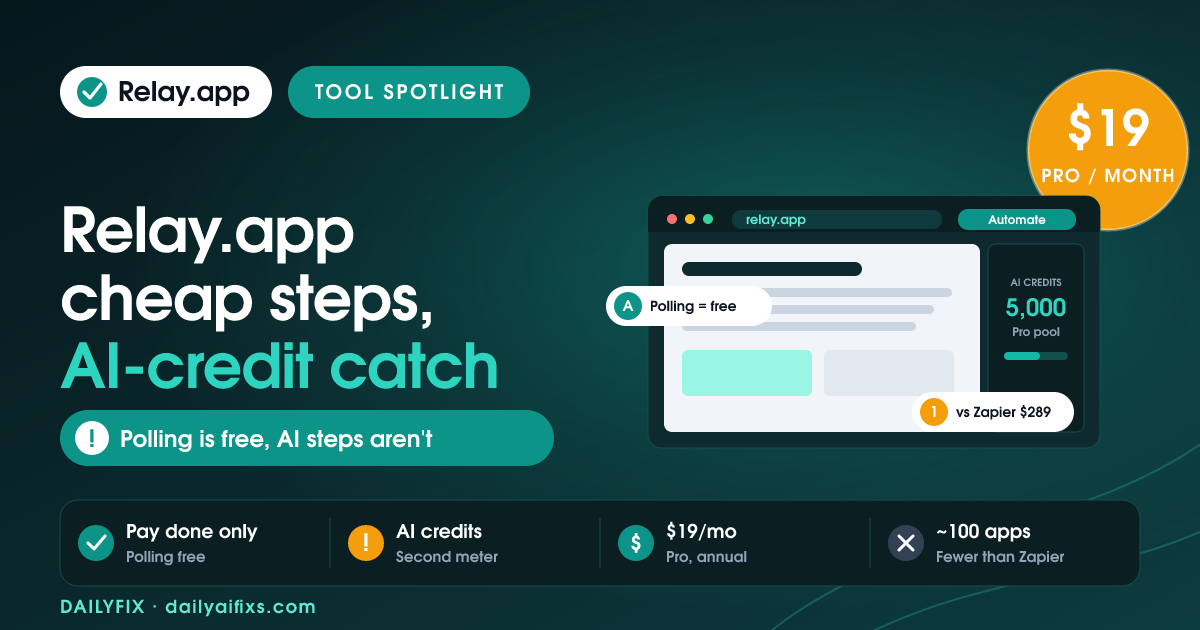
TL;DR: Relay.app pricing only charges for completed steps, not polling, which makes it much cheaper than Zapier at the same volume. The catch: AI credits are a second meter. Free gives 200 steps and 500 AI credits, Professional is $38/month ($19 annual), and Team is $138/month. AI-heavy workflows burn credits you then top up separately.
Last updated: July 2026 · By Sandeep Singh, DailyFix
Relay.app is a fast-growing automation platform positioned as a cheaper, more human-friendly alternative to Zapier, with AI steps and human-in-the-loop approvals built in. As of July 2026, its headline pricing story is genuinely good: you pay only for actions it completes for you. The part that surprises people is the second meter running alongside steps, and it is the one that scales with how much AI your workflows use.
What are the Relay.app pricing plans in 2026?
Relay.app has four tiers: Free, Professional ($38/month, or $19/month billed annually), Team ($138/month), and custom Enterprise. According to Relay.app's pricing page (checked July 2026), every plan includes all features, so paid tiers buy higher usage limits and seats rather than unlocking capabilities. Annual billing takes 50 percent off Professional and Team.
Relay.app frames the plans by volume and team size. Professional suits one to two teammates running up to roughly 10,000 automations a month, while Team supports up to about 25,000 automations with as many seats as you need. For a solo builder or small agency, Professional at $19 annual is a strong-value entry, and Team is the step up when you add collaborators.
What does the Relay.app free plan include?
The Relay.app free plan includes 200 steps per month, 500 AI credits and one user, with every feature available. It is not a feature-locked trial; you get multi-step workflows, app integrations, AI steps and human-in-the-loop steps at lower limits.
That makes the free plan a real place to build, not just a demo. You can wire up a genuine client workflow, test it end to end, and confirm the logic before paying. The limits that bite first are the 200 steps and 500 AI credits, so a workflow with several AI steps will exhaust the AI credits well before the step count. Plan to upgrade once the automation runs regularly.
What is the difference between Relay.app steps and AI credits?
Relay.app steps meter completed workflow actions, while AI credits meter the AI-powered steps inside your workflows, and they are two separate balances. A workflow can sit comfortably within its step limit and still stall because it ran out of AI credits. The free plan includes 500 AI credits and Professional includes 5,000.
This two-meter design is the catch in a sentence. The step meter is cheap and forgiving because polling does not count, but every AI step, such as summarizing an email or classifying a lead, draws down AI credits. If your workflows lean heavily on AI, the AI-credit balance, not the step count, is what you will hit first, and topping it up is a separate purchase from your plan.
Relay.app vs Zapier pricing: how much cheaper is it?
Relay.app is substantially cheaper than Zapier at the same volume because it only charges for completed steps and does not count polling, while Zapier bills per task including many trigger checks. Relay.app's own pricing page shows roughly $59 versus $289 at 25,000 automations, per Relay.app (checked July 2026).
The reason the gap is so wide is the definition of what you pay for. On Zapier, a Zap that checks an app every few minutes can burn tasks even when nothing changes. On Relay.app, only successfully completed actions count, so a workflow that watches for a rare event costs almost nothing until that event fires. For high-frequency, low-yield triggers, Relay.app can cut a bill dramatically, provided your AI-credit usage stays modest.
How much do extra Relay.app AI credits cost?
Extra Relay.app AI credits are purchasable at any time from billing, ranging from about $19 per month for 10,000 credits up to $1,199 per month for 1,000,000 credits, per Relay.app (checked July 2026). They stack on top of your plan's included credits.
Because AI credits are their own meter, treat them as a separate budget line, especially if you resell automations to clients. A workflow that classifies every inbound lead or drafts replies can consume credits quickly. The tactic that protects your margin: estimate AI steps per run, multiply by expected volume, and either pick a credit pack that covers it or pass the AI-credit cost through to the client rather than absorbing a surprise top-up.
Relay.app plan comparison (2026)
| Plan | Price | Steps / automations | AI credits | Users |
|---|---|---|---|---|
| Free | $0 | 200/mo | 500 | 1 |
| Professional | $38/mo ($19 annual) | Up to ~10,000/mo | 5,000 | 1–2 |
| Team | $138/mo | Up to ~25,000/mo | 5,000 | Unlimited |
| Enterprise | Custom | Custom | Custom | Custom |
Extra AI credits: ~$19/mo (10,000) to ~$1,199/mo (1,000,000). Prices and limits change often — verify on the official pricing page before deciding.
Frequently asked questions
Is Relay.app free?
Yes. Relay.app has a free plan with 200 steps per month, 500 AI credits and one user, and every feature is included. Unlike some rivals, the free tier is not feature-locked; you just get lower usage limits. It is enough to build and test real workflows before upgrading to a paid plan.
How much does Relay.app cost per month?
Relay.app has a free plan, a Professional plan at $38 per month ($19 per month billed annually) for one to two users with up to about 10,000 automations, a Team plan at $138 per month with unlimited seats and up to about 25,000 automations, and custom Enterprise, as of July 2026. Annual billing takes 50 percent off the paid plans.
What counts as a step in Relay.app?
In Relay.app a step is any action successfully completed for you, such as adding a row to a Notion database or sending a Slack message. Crucially, checking or polling another app for new data does not count as a step. That is a real difference from task-based tools, where triggers and polling can eat into your quota even when nothing happens.
What is the difference between steps and AI credits?
Steps meter completed workflow actions, while AI credits meter the AI-powered steps in your workflows, and they are two separate balances. A workflow can be within its step limit but still stall if it runs out of AI credits. The free plan includes 500 AI credits and Professional includes 5,000, after which you buy more separately.
How much do extra Relay.app AI credits cost?
Extra Relay.app AI credits are purchasable from your billing settings, ranging from about $19 per month for 10,000 credits up to $1,199 per month for 1,000,000 credits, as of July 2026. Because AI steps draw down this separate balance, heavy AI use can add meaningfully to the base plan price, so budget it as its own line item.
Is Relay.app cheaper than Zapier?
For most automations, yes. Relay.app only charges for completed steps and does not count polling, while Zapier bills per task including many trigger checks. Relay's own pricing page shows large savings versus Zapier at the same volume, for example roughly $59 versus $289 at 25,000 automations. Just factor AI credits into the comparison if your workflows lean on AI steps.
Who should not use Relay.app?
Skip Relay.app if you need a very large catalog of niche integrations, since it supports around 100 apps and focuses on deep, high-quality ones rather than breadth. Zapier or Make cover far more services. If your stack depends on an obscure tool Relay.app does not integrate with yet, a broader platform is the safer choice.
Bottom line
Relay.app is one of the best-value automation platforms in 2026, especially for high-frequency workflows, because it only bills completed steps and ignores polling, undercutting Zapier by a wide margin. Start free, move to Professional at $19 annual for real work, and step up to Team when you add collaborators. The one thing to watch is the AI-credit meter: it runs separately from steps, and AI-heavy workflows will hit it first. Budget AI credits as their own line, pass them through to clients where you can, and Relay.app is hard to beat on price.
Sources
- Relay.app official pricing page (checked July 2026)
- Lindy — Relay.app pricing breakdown, 2026
Related reads
- Zapier Pricing 2026: The Shared Task-Pool Catch
- Pipedream Pricing 2026: Credits Are Compute
- Make Pricing 2026: The Credit Multiplier
- n8n Pricing 2026: When Cloud Beats Self-Hosting
- Gumloop Pricing 2026: The $244 Team Jump