Trigger.dev Pricing 2026: The Usage Catch
TL;DR: Trigger.dev pricing in 2026 has a Free plan with $5 of monthly usage and 10 concurrent runs, Hobby at $10 per month, and Pro at $50 per month. The catch: those plan prices are usage credits, not flat caps. Compute bills per second by machine size, plus $0.25 per 10,000 runs, so heavy jobs cost extra.
Last updated: August 2026 · By Sandeep Singh, DailyFix
Trigger.dev is an open-source platform for running TypeScript background jobs and long-running tasks, and its Trigger.dev pricing in 2026 looks cheap until you read how usage works. As of August 2026 the monthly plan fee is really a bucket of usage credits, and compute meters per second on top. Here is what the tiers cost and where the meter runs.
What does the Trigger.dev free plan include?
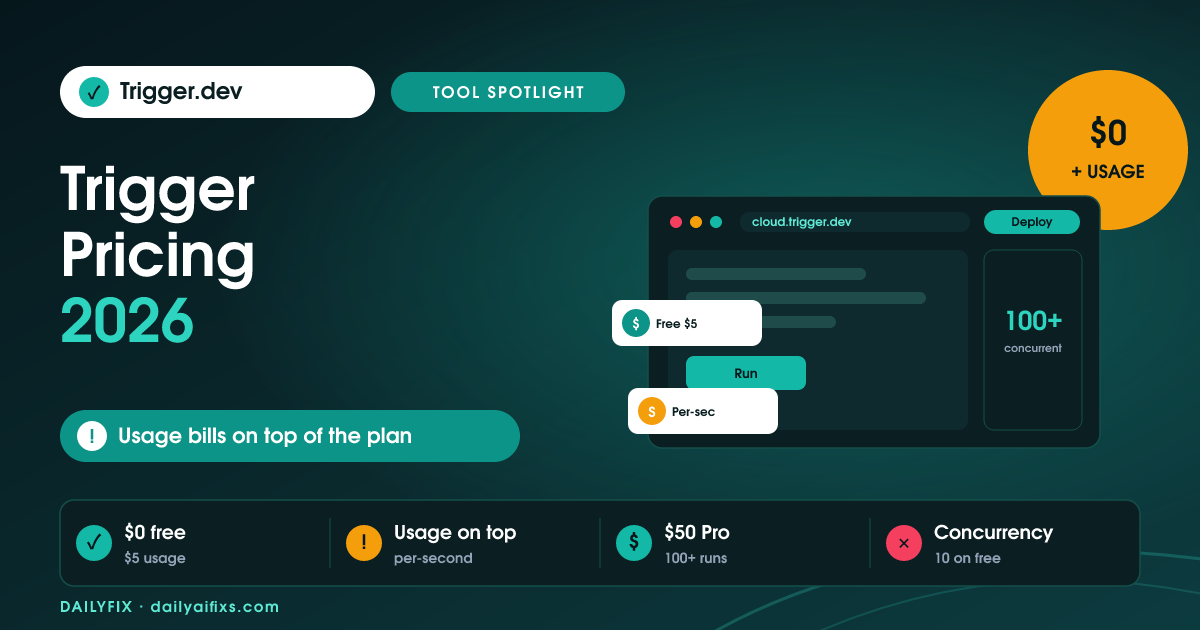
The Trigger.dev free plan includes $5 of monthly usage, 10 concurrent runs, unlimited tasks, up to 5 team members, dev and prod environments, 10 schedules, and 1-day log retention. It is enough to build and test a real project before paying.
The free tier is generous for evaluation but the $5 usage allowance and 10 concurrent runs are the walls you hit first. A busy app that fans out many jobs at once will exhaust concurrency quickly, which is the nudge toward Hobby or Pro.
How much do the Trigger.dev Hobby and Pro plans cost?
The Trigger.dev Hobby plan costs $10 per month with $10 of included usage, 25 concurrent runs, and 7-day log retention. Pro costs $50 per month with $50 of included usage, 100+ concurrent runs, 25+ team members, and 30-day log retention, according to Trigger.dev's pricing page checked in August 2026.
Both plans include usage credit equal to their price, so a $50 Pro plan bundles $50 of compute. Above that, you pay as you go. Enterprise pricing is custom and adds SSO, role-based access, and SOC 2 compliance for teams that need it.
How does Trigger.dev compute usage billing work?
Trigger.dev compute usage billing charges per second by machine size, from about $0.0000169 per second for a Micro machine to $0.00068 per second for a Large 2x, plus a per-invocation fee of $0.000025 — roughly $0.25 per 10,000 runs. Usage stacks on top of your plan credit.
This is the catch most people miss: the plan fee is not a ceiling. A workload with long-running or memory-heavy tasks burns compute fast, and once you pass the included credit the bill grows with real usage. Estimate your job durations before assuming $10 or $50 covers you.
What are Trigger.dev concurrency limits?
Trigger.dev concurrency limits cap how many runs execute at once: 10 on Free, 25 on Hobby, and 100+ on Pro. Concurrency, not total runs, is usually the first limit a growing app hits.
If your workload spikes — many webhooks or scheduled jobs firing together — a low concurrency cap queues the overflow. That is fine for background work but a problem for anything time-sensitive, so match the tier to your peak load, not your average.
Is Trigger.dev pricing worth it for developers?
Trigger.dev pricing is worth it for developers who want managed, observable background jobs in TypeScript without running their own queue infrastructure. Free covers side projects, and $10 to $50 handles most small production apps if jobs are light.
It is less attractive if your tasks are long or compute-heavy, where per-second billing can outrun the plan credit and a self-hosted queue might be cheaper. For teams that value the developer experience and observability, though, the price is fair for what you skip building.
| Plan | Price | Included usage | Concurrency |
|---|---|---|---|
| Free | $0 | $5 / month | 10 concurrent runs |
| Hobby | $10 / month | $10 / month | 25 concurrent runs |
| Pro | $50 / month | $50 / month | 100+ concurrent runs |
| Enterprise | Custom | Custom | Custom + SSO, SOC 2 |
Prices and limits change often — verify on the official pricing page before deciding.
Frequently asked questions
Is Trigger.dev free to use?
Trigger.dev has a Free plan with $5 of monthly usage, 10 concurrent runs, unlimited tasks, and 1-day log retention. It is enough to build and test a real project, but the small usage allowance and low concurrency push busy apps toward a paid plan.
How much is the Trigger.dev Pro plan?
The Trigger.dev Pro plan is $50 per month, which includes $50 of usage, 100+ concurrent runs, 25+ team members, and 30-day log retention, according to Trigger.dev's pricing page checked in August 2026. Compute above the included credit bills on top.
Does the monthly plan cover all my usage?
Not necessarily. The plan fee is a usage credit equal to its price, not a hard cap. Compute bills per second by machine size plus about $0.25 per 10,000 runs, so long or heavy jobs can push your bill above the plan price.
What is the difference between Hobby and Pro?
Hobby is $10 per month with $10 usage, 25 concurrent runs, and 7-day logs. Pro is $50 per month with $50 usage, 100+ concurrent runs, more team members, and 30-day logs. Pick Pro when concurrency or log retention on Hobby runs short.
Can I self-host Trigger.dev?
Yes. Trigger.dev is open source, so you can self-host it and avoid the cloud usage fees, trading the managed experience and observability for running your own infrastructure. For long or compute-heavy jobs, self-hosting can work out cheaper.
How is Trigger.dev compute priced?
Compute is billed per second by machine size, from roughly $0.0000169 per second (Micro) to $0.00068 per second (Large 2x), plus a per-invocation fee of about $0.25 per 10,000 runs. This usage stacks on top of your monthly plan credit.
Who is Trigger.dev best for?
Trigger.dev is best for developers who want managed, observable TypeScript background jobs without building their own queue. Free suits side projects; $10 to $50 handles small production apps with light jobs. Heavy workloads may be cheaper self-hosted.
Is Trigger.dev open source?
Yes. Trigger.dev is open source, and version 3 opened to everyone, so you can self-host the platform and avoid cloud usage fees entirely. Self-hosting trades the managed, observable cloud experience for running your own infrastructure, which can pay off for long or compute-heavy background jobs.
Bottom line
Trigger.dev is a strong, developer-friendly way to run background jobs without managing your own queue, and Free through Pro covers most small apps. Choose Free for side projects, Hobby or Pro for light production workloads. Just remember the plan price is a usage credit, not a cap: per-second compute and per-run fees stack on top, so long or memory-heavy tasks can cost more than the sticker. If your jobs are big, price out self-hosting the open-source version before committing to the cloud tiers.
Sources
Related reads
- n8n Pricing 2026: When Cloud Beats Self-Hosting
- Make Pricing 2026: The Credit Multiplier
- Zapier Pricing 2026: The Shared Task Pool Catch
- Activepieces Pricing 2026: Flows, Not Tasks
- Latenode Pricing 2026: You Pay for Seconds